City owes Wanderers $590k on stadium
HRM took control of “pop-up” stadium in 2025
by Josh Healey
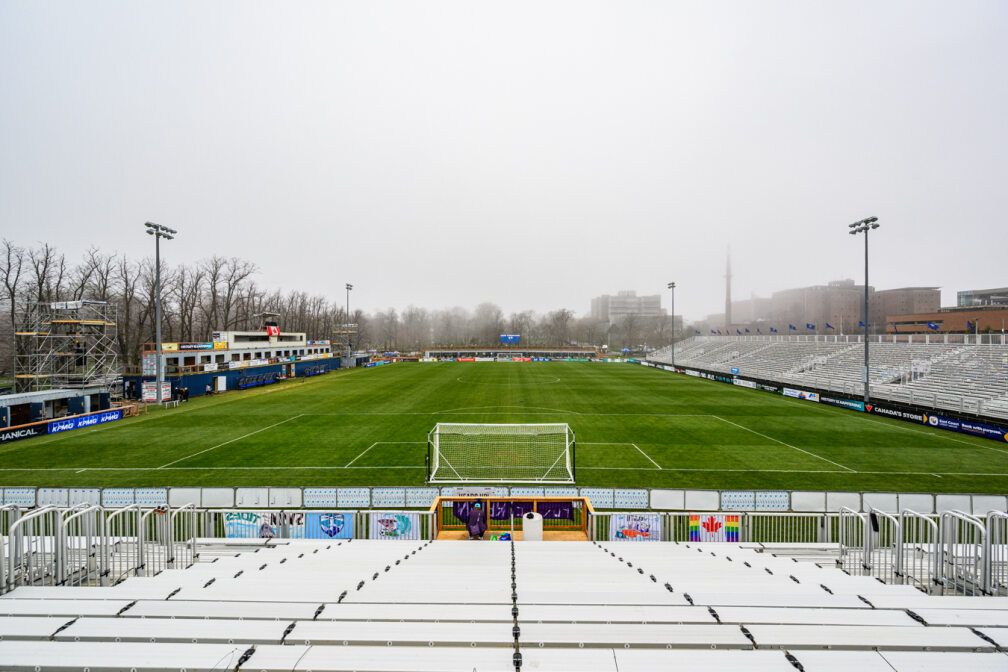
The city’s audit and finance committee met last week and reviewed Halifax’s first year of managing the Wanderers Grounds “pop-up” stadium. A staff report noted operating costs went $590,385.10 over budget. That amount is now owed to Halifax Wanderers FC, which has a service agreement with HRM. Meanwhile, the decision on a permanent stadium and the potential redevelopment of the Wanderers Block to the tune of $116 million looms on the horizon.
Staff highlighted that the city’s stadium budget was approved relying on early assumptions and information supplied by the Wanderers, who had previously managed and operated the site. HRM took over the Wanderers Grounds in 2025 to provide equal access to the city’s other professional football team, the Halifax Tides FC of the Northern Super League (NSL).
Several stadium upgrades were required to make room for two professional soccer clubs, including expanded team spaces, relocating the media areas, electrical work, and improved services for food and beverage. Making the stadium fit for two teams instead of one costs more than staff expected.
“Operating costs for the stadium exceeded the approved budget due to a combination of factors,” said staff in the report, also listing additional staff to change over the stadium’s signage (the Tides and Wanderers have different sponsors), all of which increased costs. The part of the Tides agreement with HRM that includes changing marketing materials between matches due to the different sponsors of the Wanderers was not included in staff’s initial Wanderers-based cost assumptions. The report noted that labour to change out and store signage “was greater than originally anticipated.”
Some costs claimed by the Wanderers as stadium operating expenses were rejected. Staff added that despite the challenges, the Wanderers Grounds hosted 28 first-team matches between the city’s two professional football clubs, not to mention several more high profile sporting events like the Canadian National Men’s team’s visit last June.
Changes are expected to prevent future shortfalls. “The full scope of stadium operations and the associated costs are now understood and will be recovered through adjustments to fees and a reduction in the scope of stadium services provided through HRM,” wrote staff.
The committee ultimately deferred the vote to pay the outstanding $590,385.10 as they requested a supplementary report based on questions raised in an In Camera session.
Both the Wanderers and Tides are asking HRM to build a permanent stadium at the Wanderers Grounds as the current facility lacks proper seating, running water, and flushing toilets. This ask goes back to 2023 when Wanderers founder and president Derek Martin pitched his $40 million stadium vision to this same committee.
After that 2023 meeting and consultations with stakeholders throughout the Wanderers Block, staff presented a report in August 2025 with three different options to redevelop the plot of land that currently hosts the temporary stadium, a horse riding school, and several other facilities.
The proposed permanent stadium, ranging in size from 7,100 to 8,600 seats, is baked into the three redevelopment plans including other facilities, meaning councillors are weighing price tags between $116 to $122 million for the lot. Staff are currently working on a financial feasibility assessment after several councillors raised concerns over the cost and if the city should be spending that kind of money given their long-term financial difficulties; the city currently has $226 million in outstanding debt for capital projects that need to be repaid. District 7, where the Grounds are located, runs an estimated annual surplus of $86 million.
Both the Wanderers and Tides have said they are willing to work with the city, with Wanderers president Martin confirming his club was ready to sign a 25-year lease and pay a significant portion of the stadium cost. Dr. Courtney Sherlock, the CEO and co-founder of the Tides, said her club is also ready to make an investment.
“We do need some improvements,” Sherlock told Grand Parade. “It’s a great location, everybody agrees with it, the economic impact we have there is enormous. Nobody disagrees with that, but we just need to focus on some improvements, like running water.
“We’re certainly talking to the city, they’re asking what our needs are, and we’re talking about how we can help them. We’ve got some infrastructure money we can help to put towards it.”
Sherlock added that the Tides are still in negotiations to sign their lease agreement for 2026. Previously, they signed a one-year contract. The Wanderers’ lease will also end soon, as they signed an extension through 2026. But all sides will be looking at possible changes to their agreements, not to mention long-term stadium discussions, as HRM settles in as the operator for a stadium they’re only just beginning to understand.
HRM’s Green Network Plan stalls out: After 7 years plan only 17% complete
by Matt Stickland
Back in 2018, a year before Halifax declared a climate emergency, the city was worried about the negative impact of human development on the natural world. So council of the day passed something called the Green Network Plan (GNP) to protect what’s left of our precious natural environment as the city grows and develops.
On top of preserving what wilderness we can while we grow, the GNP also aims to put a value on the benefit of the natural world.
For example, a preserved natural corridor can also provide travel lanes for bike riders and walkers who are commuting or just enjoying nature.
Unlike driving a car on a road, which is an anti-social, polluting activity that causes social isolation, produces exhaust which causes alzhimers all the while increasing travel fatalities, riding a bike on a nature trail boosts cognitive functioning, decreases mortality and gives people a greater sense of belonging with their city and community. And walking or rolling on a nature trail is accessible to more people, since walking through nature is not a licensed activity that requires people to be a certain age and healthy enough to operate heavy machinery.
In 2018, staff predicted the plan would be fully implemented by 2025. It’s unclear why staff thought this, as the GNP was passed in 2018 without any of the legislative changes required for the plan’s success.
As a result, a year after the plan’s estimated completion, it’s 17% complete. About 71% of the plan has some degree of progress, and about 10% of the to-be-completed-in-2025 plan has not been started at all as 2026 rolls around.
One of the reasons the GNP has recently been implemented more rapidly is that in spring of 2024, Halifax hired someone to finally get around to start making those legislative changes to mandate the GNP’s adoption.
The plan faces political challenges from within and without; for example, from within, mayor Andy Fillmore has been advocating to cut Halifax’s climate adaptation tax, HalifACT, which would cut funding for parts of the Green Network Plan, such as the renaturalization of our lakeshores.
And from without, the province has done stuff like prioritizing nature for development, with special planning areas like the area by Blue Mountain-Birch Cove Lakes.
One councillor leading the charge to speed up this plan’s implementation is deputy mayor Patty Cuttell. Her district has experienced increased flooding and stormwater management issues, which correlate with the recent development boom in her district. At last week’s GNP debate, she said she was concerned about “the limitations in the municipal charter and the other constraints we face as a municipality in realizing the fullness of this plan.” She continued to say it was a lack of tools, not political will, that was holding back our city’s municipal council.
For example, action 60 of the GNP is to “continue to study and consider the adoption of infrastructure charges to support the development and improvement of parks and recreation facilities that are needed to support new development.” The city says it can’t make any progress on this because they want to use clause 284 to charge special development fees for Green Network Plan infrastructure, and the province has made it impossible for the city to make housing more expensive to build by raising development fees.
This would be no problem for a council that didn’t lack for political will, because luckily, clause 29 of the Halifax charter says council “may determine expenditures, to be financed by area rate, that should be made in, or for the benefit of, the community,” which could be things like the Green Network Plan.
Using clause 29 instead of 284 shifts the burden of paying for infrastructure from the people who build housing and infrastructure to the people who will use the housing and infrastructure. Shifting that burden is only a problem for Halifax’s city council if their municipal by-laws allow for, or mandate, fiscally unsustainable land uses.
On top of area rates, clause 153 of the Motor Vehicle Act (and clause 60 of the charter) gives council the power to charge higher fees to cover costs from things that work against the Green Network Plan’s success, like driving and its required road infrastructure.
None of the 11 councillors at last week’s meeting put forward a motion to use some of their collective will or available municipal tools to expedite the Green Network Plan. But they will get another opportunity to exercise their abundant political will and put forward motions when this GNP update comes to council in the near future. And failing at that, deputy mayor Cuttell also reminded folks that “if there’s things that need to be taken forward into budget, we can do that.”
The other stuff
There’s a new podcast in your feeds. At first, it was gonna be a shorter episode, but then I listened back to the Party Rock Anthem episode from last summer, and it’s still painfully relevant and a good budget primer, so that segment is also in this show.
That whole book club thing seems to be a popular idea, so we will be reading Killed by a Traffic Engineer, by Wes Marshall and meeting to talk about it on Sunday, March 1, at 2:30 pm at Celtic Corner in Darmouth. Please email matt@grandparade.news to let us know if you plan to come by Valentine's Day. Won't hold you to the RSVP; the pub just wants a better idea of the numbers so they know where to put us.
And just a note, if you’re unfamiliar with podcasts, wherever you normally listen to podcasts is where you can find the show. I just use the Spotify link because the link to the show page is the link that works best for this newsletter. Want the link? Here’s the link.
Want some somatic satiation? Link, link, link, link, link, link, link, link, link, link, link.
Here’s this week’s digital issue for your at-home crossword needs. I’ve tried to make the puzzle a little bigger in this issue just in case you, like me, still use giant block letters.
How’d you do on last week’s puzzle? Here are the answers.