
Potholes cause budget breakdown
Halifax's money pits are multiplying faster than ever

Editor’s Note: During budget season, paywalls will drop off after a week.
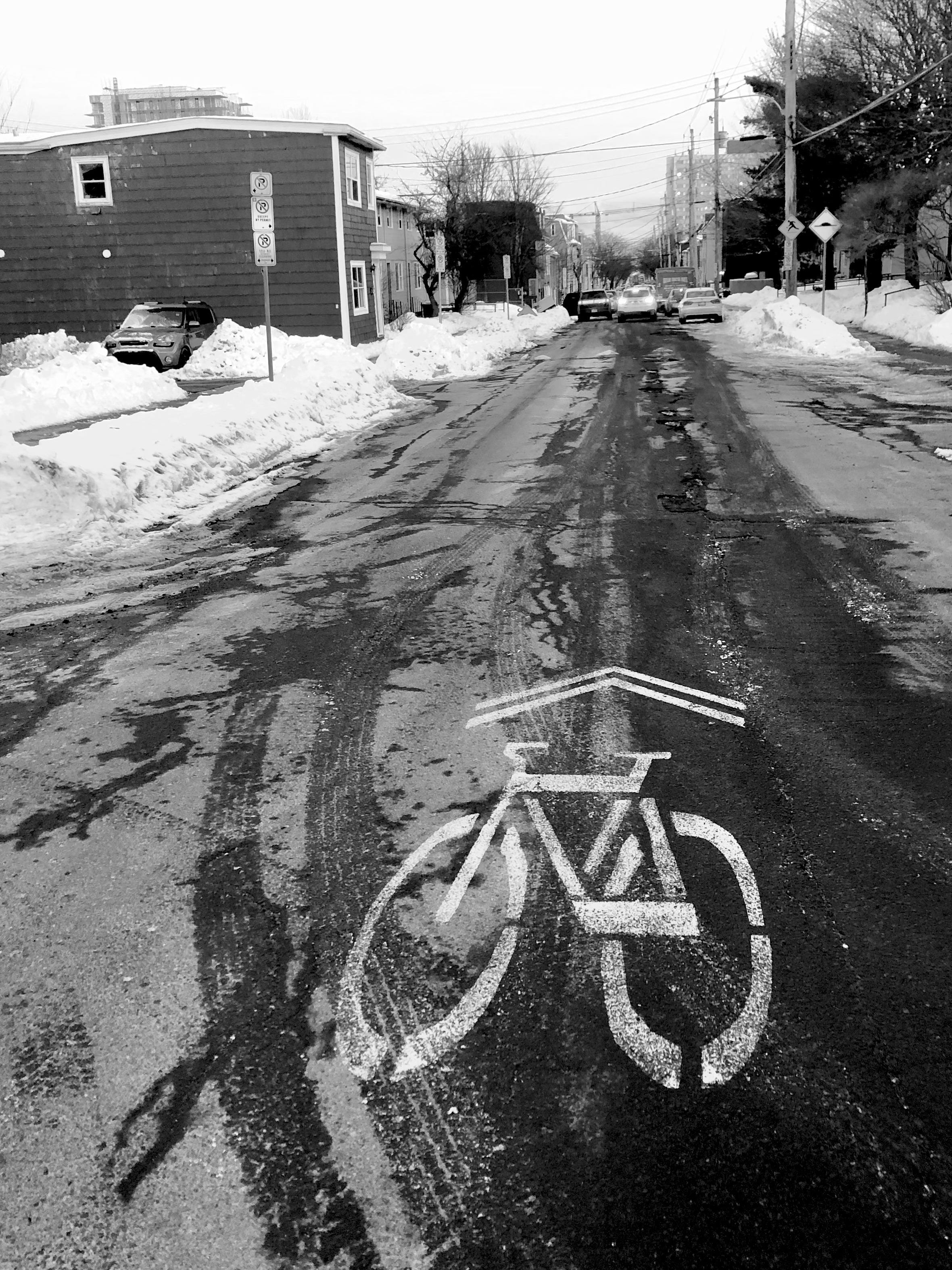
by Giancarlo Cininni & Antonia Zwissler
“I just wanted to focus the conversation,” said District 7 councillor Laura White at a Feb. 4 budget committee meeting. “What we’re trying to do here is save lives, and I fully support doing that sooner rather than later.”
White’s comment came after mayor Andy Fillmore made the case for slowing the pacing of road safety spending to decrease annual expenditure.
The debate was sparked by District 5 councillor Sam Austin’s appeal to spend $960,000 on building out Halifax’s road safety program faster.
The spending includes $70k for 10 flashing beacons at crosswalks, $100k for five accessible pedestrian signals, and $300k for durable, high-vis crosswalk markings. At the Feb. 4 meeting, staff estimated current baseline annual safety spending is $5m.
The city reported 11 people killed in motor vehicle collisions in 2024. The final numbers for 2025 aren’t out yet, but unoffical counts are at ~25 people killed by drivers. As reported by Haley Ryan at CBC in October last year, the HRM’s supervisor for safety and transportation Sam Trask said preliminary reports show 20 people had been killed in road collisions by August 2025. Either way Halifax had one of its worst years on record for road deaths.
Among those killed last year were Maverick Brown (age 3), Noland Lillington (age 16), Fraser Lake (age 17), and Alexandria Wortman (age 21).
Austin’s $960k motion includes funds to hire a Program Manager whose job would include communicating with police. At the meeting, District 10 councillor Kathryn Morse pointed out that even with a population increase of 100,000, police issued about half as many traffic tickets last year as they did in 2016. This is despite budget increases for the HRP, and RCMP, including increases in funds allocated to the HRP’s traffic department.
“We are not going in the right direction, we are seeing more injuries and deaths on our streets and the trend is going opposite of where we want it to be,” said Austin. “Our challenge is we’ve basically been given 60-80 years of infrastructure that was built with only cars in mind, and that’s a tall order to fix.”
District 4 councillor Trish Purdy argued against accelerating the road safety program because adding requirements for street construction decreases the amount of pothole repair the city is able to do saying that “residents are already frustrated by the deteriorating pavement structure and the increasing potholes.”
Austin’s motion to spend $960k more on road safety this year passed 10-4. Fillmore, Billy Gillis (District 15), David Hendsbee (District 2), and Purdy lost the vote to save money on road safety.
The city’s Public Works department notes in this year’s draft business plan that since Halifax is saving money by letting more roads fall into disrepair, “the need for operational reactive maintenance is increasing (i.e., increased need for pothole repairs).”
To try to fill the fiscal potholes in this year’s budget, District 4 councillor Trish Purdy proposed taking longer to build out Halifax’s cycling network since council was against lowering safety standards to save money. She made the same suggestion the week before, and it is already on the list of potential budget changes to be discussed on March 4.
In a press scrum, Fillmore said if the city decides to build a strictly All Ages and Abilities bike network, construction would have to be completed over a longer period of time due to higher costs. “The alternative that I’m proposing, and that I like, is that we built it faster and cheaper, in a way that’s still safe and meets needs.”
Purdy also raised the concern that “complete streets constricts the ability for good ol’ maintenance.” But good ol’ maintenance without traffic calming measures mean faster streets. Multiple studies show roundabouts, curb extensions and speedbumps all reduce speeds and save lives. And, as reported by the Economist in January of 2020, spending more money on paving, without investing in traffic calming measures increases traffic related fatalities.
In transportation planning policy, “complete streets” refers to making roads accessible to all users instead of just drivers. This is done through networks of specialized routes; from continuous protected bike lane routes all the way through arterials for trucks and transit with wider lane minimums. It’s part of Halifax’s Street design standards (AKA Red Book), and its Integrated Mobility Plan.
In an interview with Grand Parade, Dalhousie School of Planning professor Ahsan Habib said “it shouldn’t be a zero-sum game.” He said calming measures should be implemented where they are needed, not on arterials, for example. Habib said the Integrated Mobility Plan is good, but that the city appears to be picking at parts of the plan rather than implementing the plan as a whole. He stressed the importance of completing networks for all modes. “There shouldn’t be debate about which mode we prefer, instead we need to prefer all modes, depending on where it will work.”
The literal enshittification of the Salt Marsh Trail
by Matt Stickland
One of the HRM’s most scenic trails, the Salt Marsh Trail, is being overwhelmed by dog shit. For years the city picked up garbage in the provincial park, but stopped doing so last year due to budget cuts. And when the city stopped picking up the trash it became obvious that people follow the instructions on no littering signs as diligiently as they adhere to posted speed limits. The shit-uation got so bad volunteers tried to remove garbage cans to try and deter people from littering.
The councillor for some of the trail, Trish Purdy, who told the Budget Committee last Wednesday she is “taking seriously that we have to try to lower this tax rate,” brought forward a motion to restart that service. Purdy also told Grand Parade in a scrum that Halifax is “not spending enough on our roads.” Car infrastructure is the other expense Purdy wants to foist on the tax burden. At last Wednesday’s meeting, Purdy told her peers that “for about 20 some years, Halifax was picking up the garbage disposals at our provincial parks, Heritage Park and our Salt Marsh Trail. And just last year, we stopped performing the service.” She argued that since “our garbage trucks go right by there anyway,” it wouldn’t take that many property tax dollars to pick up the province’s garbage bill. After adding up property taxes and subtracting the cost of city services, District 4 (where some of the Salt Marsh Trail is) cost the city $9 million last year. Purdy concluded the Salt Marsh Trail Association “really don’t receive as much money as they need to perform all of the work they do. And they rely heavily on a group of very dedicated volunteers who, you know, sacrifice their time, their talents and their machinery to do all of the work that’s needed on these trails.”
Other councillors who also have provincial trails with similar garbage issues flatly panned the idea that Salt Marsh get special treatment. Councillor Sam Austin said, “I don’t know. I’m torn,” before voting for Purdy’s motion. The vote failed 5-12. This small defeat for Purdy is also a small win for Purdy, who is seriously trying to lower the tax rate.
Cops can use choke holds
by Matt Stickland
Halifax’s cops are still allowed to choke you out, but only by choking off blood and oxygen to your brain instead of cruching your trachea. The Vascular Neck Restraint (VNR) comes from the Judo school of Shime-Waza AKA choking techniques. And Shime-Waza has three main chokes types; compression of the neck-veins which restricts the flow of blood and oxygen to the brain, compression of the trachea, and compression of the chest and the lungs.
In studies, like the 2012 “Hemodynamic Effcts of a Vascular Neck Restraint” they choked out 24 young healthy cops in a controlled environment and found that the VNR did cut blood flow off to the brain, but not the heart, so it was safe. And in 2022 a literature review “Safety of Vascular Neck Restraint applied by law enforcement officers” found “there have been case reports of significant injuries including carotid dissection and stroke; death has been reported as well.” And “in addition, there have been cases of in-custody deaths that have occurred after apparent neck manipulation.” But except for those times, and noting “potential limitations due to missed injuries or recording errors” that review found that when VNR was done right, by trained cops, it was “both safe and effective.”
Even though the city says the VNR is safe, the American Academy of Neurology disagrees writing in a position statement that “The medical literature and the cumulative experience of neurologists clearly indicate that restricting cerebral blood flow or oxygen delivery, even briefly, can cause permanent injury to the brain, including stroke, cognitive impairment, and even death. Unconsciousness resulting from such maneuvers is a manifestation of catastrophic global brain dysfunction. In addition, individuals with underlying cardiovascular risk factors are more vulnerable to suffering significant neurological injury from neck restraint techniques. ... In sum, the neurological sequelae that result from limiting blood flow or oxygen to the brain due to the use of neck restraints are potentially irreversible and entirely preventable.”
In 2023 the federal government ordered the RCMP to ban “the use of neck restraints in any circumstance” in a mandate letter to then RCMP chief Brenda Lucki. The RCMP, citing the two studies above, instead gave it’s members new instructions that “strengthens and clarifies definitions, oversight and accountability measures, the risks of applying the technique on medically high-risk groups, requirements for medical attention, the threshold for use and requirement to recertify annually on the policy regarding application.”
The Other Stuff
New podcast is out this week, it’s a fun one (spoiler alert: during budget season, there is no such thing as fun, we have a losing team, so our seasons mostly suck.)
Doing the crossword at home? Here’s the digital issue.

How’d you do on last week’s puzzle? Here’s the answer