
Robie expansion takes the spotlight at budget hearing
Keeping 900m of one car lane will cost $200 million

Editor’s Note: During budget season, paywalls will drop off after a week.
by Giancarlo Cininni & Antonia Zwissler
Over 20 visitors sat in the gallery at city council on Jan. 27. One by one they came down to the podium in front of council and shared their thoughts on the 2026/27 city budget.
First up was founder and president of New Roots (a community land trust in the North End) Treno Morton. He urged council to transfer a parcel of land in the Cogswell redevelopment area to New Roots, a request first made three years ago. New Roots wants to build 430 affordable units for Black residents being priced out of the neighbourhood. Many come from families previously displaced from Africville by practices of “urban renewal.” Morton asked, “will you let the bulldozers finish their job? Or will you help us build a Cogswell District that stands as a fortress for our heritage and an engine for our future?”
Three activists from Halifax’s Workers’ Alliance chapter took turns at the podium to demand the city pay janitors at Alderney Landing a living wage. The janitors had ratified a union contract before losing it when the city flipped from GDI Integrated Facility Services to Imperial Cleaners LTD. Another demand included rehiring a fired organizer, Stan.
Workers’ Alliance member Al Giacalone said “your clean chambers, your functional city, it rests on this labour. We move through public space without thinking about what we leave behind. Because someone else is assigned to clean it up. This is the logic of dependency, these workers wipe our city’s ass.”
One person, Andrew Deveaux, took the mic to ask the city not to kill the Turret Arts Space restoration project (the Khyber’s Barrington Street building).
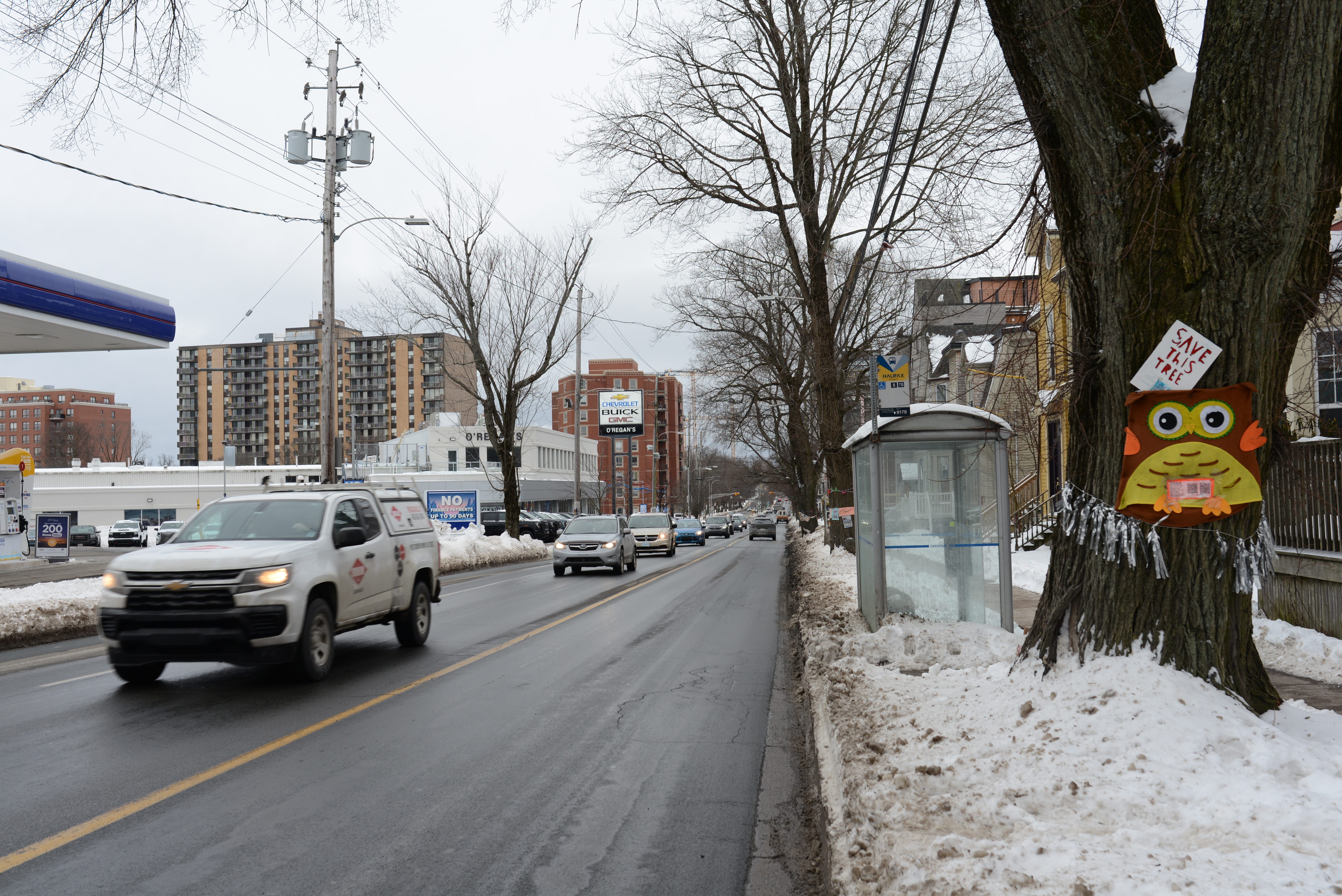
The city’s plan to widen the stretch of Robie Street between Almon and Cunard drew the most participants. Robie is a main thoroughfare cutting through the middle of the peninsula, and a prime part of building bus rapid transit (BRT), which would alleviate Halifax’s traffic woes.
Thanks to the city’s massive investment in car infrastructure, it achieved bronze in congestion nationwide last year, losing out only to Vancouver and Toronto. With its rapid population growth, and continued automotive investments, Halifax may soon be up for gold.
Widening Robie would require demolition of 90 homes – 40-70 of which are affordable housing, as well as 60 trees (HRM estimates 40 are mature). Ten residents delivered impassioned statements of disapproval.
“I haven’t heard a single person in the area around Robie street that wants this project to move forward,” said resident John Wimberly. “And then of course there is the matter of the tax increases…where (we are) hearing that things need to be axed, and then from the estimations so far, we are going to move forward with a $200-million dollar project,” he said. (Wimberley cited the Friends of The Halifax Common figure, exactly what the city will owe will depend on provincial contributions.)
Pam Cooley, executive director of the international CarSharing Association said “the traffic we are experiencing will not be solved by widening Robie Street, it just won’t.” Cooley argued that the widening plan was antiquated and used “outdated technology.” She said “rapid bus transit is an excellent solution, but BRT does not and should not require new massive construction, it’s actually meant to use the corridors we actually have. Worldwide cities use this, but they don’t build more or widen streets to get it; it’s the wrong approach.”
Of the 11 residents who brought up the issue, Jacob Hendren from Cole Harbour was the only one who prioritized two-way all-day rapid transit over protecting Robie Street. He spoke through zoom and said “the environmental benefit of BRT will outweigh the environmental consequences of losing some trees”. Hendren was skeptical that the city would replant trees, and stressed that anything less than offering affordable housing for evicted tenants would be “unthinkable.”
Six people advocated for better pedestrian safety and bike infrastructure. One was Sydney Haines, who mentioned late fellow King’s student Alex Wortman, killed by a driver a year to the day of the budget meeting.
Two people asked council not to raise property taxes, including Andrea Hilchie-Pye who lost the councillor election to District 7’s Laura White in 2024. Four people asked council not to cut the Climate Action Tax from property tax bills, including the Ecology Action Centre’s Jillian Ramsay. The Climate Action Tax is being considered as a cut thanks to mayor Andy Fillmore.
Towards the end, Fraser Parke came down to the front of the room to express sympathy for the tight budget. Parke, a registered accountant and VP of Finance & Operations at State Affairs – an American company that uses AI to communicate government affairs, took the opportunity to pitch to council. He told them to spend money on a website he’s working on with a friend that could clearly communicate the city’s lack of money to its constituents. “I’m happy to leave some business cards here,” he said.
Council cheaps out on safety
by Matt Stickland
Thanks to the budget crunch, council is taking a second look at bike lane infrastructure.
Last Tuesday, council voted to save $750,000 by making the Welsford Street segment of the city’s AAA bike network less safe for bike riders. The plan originally was to put in a separated bike lane for $1.1 million, but that would have made the road safer by narrowing it and removing on-street parking, which would have also made the road safer by reducing car traffic.
In the report, staff note that the cheap option, squares of green paint and some signs (known as a local street bikeway), is not ideal.
The local street bikeways option is a bit dangerous for bike riders because, as the staff report notes, “speed is relatively high for a local street bikeway,” so we’ll probably need to spend some currently unbudgeted money on speed humps which will cut into the $750,000 in savings..
Based on this year’s budget projections, council could also have chosen to save $750,000 by deferring the repaving of 625 meters of car lanes.
There was a bike lane that survived thanks to councillor Sam Austin urging his peers not to axe the planned Highfield Park Bikeway even though it would save $3 million. He argued that the alternative on Leaman Drive and Jackson Road doesn’t make sense because nobody lives there. He said that since everyone already lives in relatively high-density areas in Highfield Park, we should really build infrastructure where people live. And staff explained that they proposed this cost savings based on available infrastructure but didn’t consider how the cheaper lane would be used.
Council saved Highfield until Friday, when a motion from Trish Purdy to put all of this year’s bike lane spending on the chopping block at the budget adjustment list debates passed at budget committee. Last year, road paving cost the city $1.04 million per kilometre, and our car lanes were 54% good. And this year, we are spending $1.2 million per km and our car lanes will be 51% good. But council has yet to put forward a motion to put car lane spending on the chopping block despite it costing much more than bike lanes.
HRM’s debt crisis finally arrives
by Matt Stickland
After looming on the horizon and after warnings in previous annual capital budgets going back years, over a decade of low taxes and high borrowing has come back to haunt Halifax’s tax rate.
Thanks to borrowing a lot when debt was cheap to keep taxes low, council only has about $900 million in available credit, but the city’s capital plan currently has about $1.8 billion in needed spending. Or as the capital budget report reads, “the draft plan is underfunded by $1.2B.”
This year, thanks to property values increasing by 5.6%, council only needs to increase taxes by 4.9% (for a gross tax increase of a 10.9%) to almost but not quite cover all of the needed spending, thanks to growth and the rising costs of Halifax’s fiscal unsustainability.
Council created this debt emergency in three main ways. First, council kept taxes below inflation for the bulk of the 2010s. Second, since debt was so cheap, council funded stuff with it, to help keep taxes low. And third, council also procrastinated on maintenance to keep taxes low; but at the same time Halifax experienced increased growth, and therefore more wear and tear, than expected.
Debt spending needs to be repaid with interest, and deferred maintenance spending needs to be repaid with inflation.
To try and decrease the city’s capital debt burden, mayor Andy Fillmore put forward a motion to get more information about deferring the Forum redevelopment to save money.
Fillmore said that back in 2014 council could have redeveloped the forum at a cost of $15 million. Balking at the price tag, council chose to defer the redevelopment to save money, which has resulted in a price tag of $126 million, not including the emergency repairs that have kept the Forum open in the meantime. According to councillor Sam Austin, who confirmed in a Facebook comment, the city also recently voted to award Pomerleau Construction a design/build contract for the Forum, and if the city deferred the Forum, they’d still need to pay that money. On average, each year of delay has added approximately $9 million to the Forum’s pricetag.
Around the same time council’s self-inflicted crisis started to blow up in our faces, we also got a few unavoidable emergencies like COVID and climate which burned down half of Upper Tantallon and flooded other parts of Bedford.
As a result, since 2021, Halifax’s infrastructure across all municipal services has been in a steady state of decline.
The Other Stuff
I am quite sleep deprived, but I am pretty sure I scheduled this week’s episode to go live this morning and you can find it where ever you get your podcasts or right here:
Are you doing the crossword at home? Printing this out to leave somewhere so an unsuspecting Haligonian might accidentally gain some civic knowledge? Here’s your pdf.

And here are the answers to last week’s puzzle.
February 4 2026 - I just listened to your most recent council presentation. I always appreciate what you have to say, but I'm especially glad you went ahead with this BAL under challenge. I hope council is listening. Thank you for all you do.