Sam Austin tries to make city use roads better
Making sense of Halifax’s transit piorities
by Katy Jean
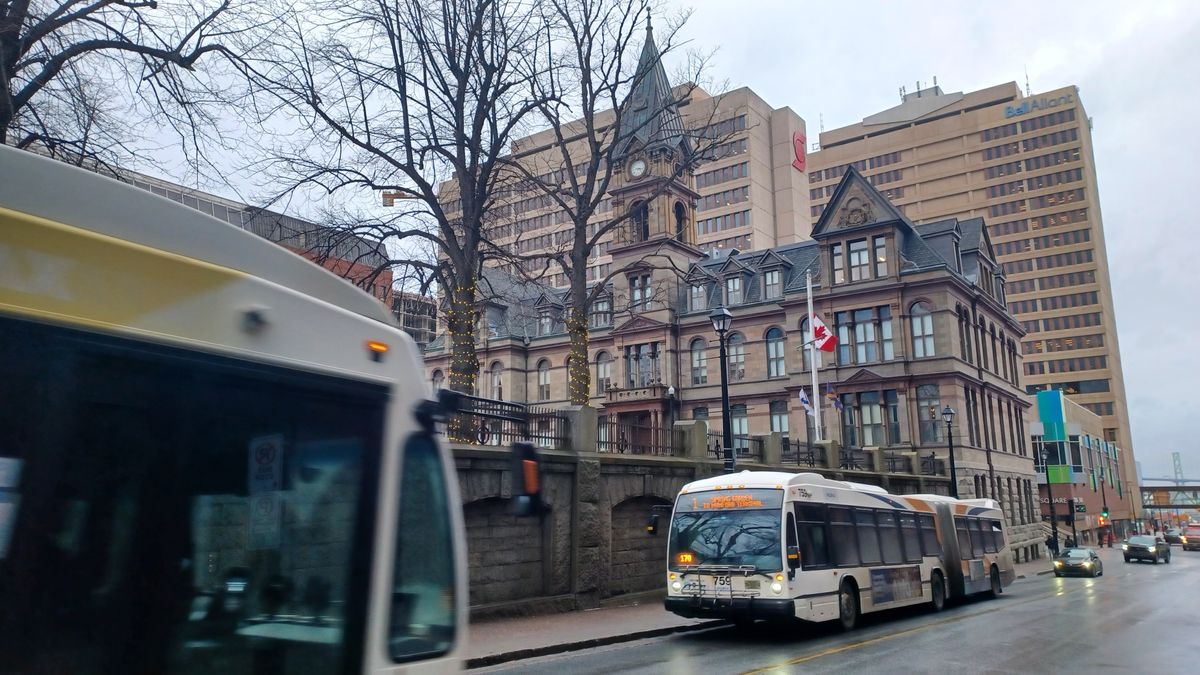
The HRM’s announcement that Wi-Fi service at transit terminals would be ending effective April 1 was widely taken as an April Fool’s joke. Because surely we weren’t cutting off a vital service for the public and transit users alike. There was no way the city could make taking transit even less accessible.
HRM had to issue an apology and a more complete clarification to a public reaction of “they must be kidding.”
“We understand the timing may cause some confusion, but this is not a joke. Public Wi-Fi use has significantly declined, and ending the service is expected to save approximately $450,000 in annual operating expenses,” reads the HRM’s statement.
Paired with the discontinuation of paper route maps and schedules, it’s as if Halifax has just given up on transit.
But the day before the not-a-joke April Fool’s debacle, there was a glimmer of what may be some hope for our transit system.
In a long-winded auctioneer type voice, councillor Sam Austin brought forward a motion to Regional Council to create a staff report on, plainly summarized, “transit prioritization.”
Austin’s motion tells staff to try and change the engineering of road allocation to create transit lanes and traffic signals on the HRM’s car-dominated roads.
The motion passed unanimously. Some councillors even chimed in on the benefits for their community.
Sam Austin explained in an interview with Grand Parade, “the city’s growing really quickly and we are seeing more traffic congestion on the roads.”
According to the Integrated Mobility Plan (IMP), 77% of daily commuters are drivers.
“This is affecting transit,” said Austin. “The on time performance for transit is decreasing. Which is actually then causing transit to add time to the scheduling of buses.”
“The buses are slower, and we are actually adjusting the schedule to make them slower to reflect reality.”
Austin explained that we can’t continue on the way we are with everyone driving, and we need to make the alternatives more attractive, like active transportation and transit.
But getting more people on the bus is “not going to work for transit if the bus is sitting in the same traffic that cars are,” said Austin. “We need to figure out ways that the bus can skip through bottlenecks and skip past choke points.”
Dedicated lanes would make sticking to the schedule easier, which would also get more kilometres of driving for every tax dollar paid for a driver’s labour.
Bus Rapid Traffic is the bus-t case scenario. But it is very expensive. Which means Halifax is years away from being in the position to begin.
“What can we do in the shorter term while working towards the real solution of Bus Rapid Transit?” asked Austin.
And that is what he is looking for.
“I did talk to staff in advance and they were enthusiastic with the idea. It’s the kind of work they used to do, regularly, not necessarily road modifications, but looking at where the busses were getting held up, but it’s something they kind of got away from over time. And so getting back to an interdepartmental working group on this is, really, what I’m hoping will come of this.”
Only 10 kilometres of transit lanes exist in Halifax right now.
Austin is optimistic staff will come back with some short-term but big ideas.
“Road reallocation projects, they have been controversial. And our provincial government has generally been pretty lukewarm to those sorts of ideas. You saw that play out with the Morris Street bike lane debate.”
“We certainly have a provincial gov. that is very much interested in the needs of drivers,” said Austin. And on the topic of the province he said they have “not so far shown any tendency towards bold decision-making in favour of transit or active transportation. And that is the biggest problematic kind of piece, of doing stuff like road reallocation or these sorts of things, because they’ve given themselves the ability to basically veto any of our transportation projects through their legislation.”
When asked what or who would be against ideas or suggestions to improve congestion, Austin commented, “the biggest potential pitfall is lack of provincial support.”
The province is proposing, in contrast to Austin’s suggestions, allowing private vehicle drivers into Halifax’s public bus lanes if the driver has a passenger or two.
Rewarding or encouraging more drivers works against the IMP, which aims to have drivers in Halifax account for less than 70% of travel by 2031.
Allowing drivers a free pass inside Halifax’s dedicated bus lanes would be one of many indignities piled on the taxpayers who want to benefit from their public transit investments without having to purchase a car.
An indignity they will now suffer without even having a bit of Wi-Fi to book an Uber instead of waiting for the bus.
Halifax has a budget
by Matt Stickland
After nine months of debate, the city of Halifax finally has a budget. This budget will see a moderate increase in taxes of 9.5% which will be used to make massive investments in public transit, firefighting, and road safety, amongst other things.
In spite of investments in the city, council faces tough fiscal headwinds. A decade of deferred infrastructure maintenance, underinvestment in infrastructure needed for growth, and keeping taxes low has led to a $4 billion infrastructure bill and huge debt repayments that the city can’t really afford.
The good news with this budget, according to mayor Andy Fillmore, is that council has made “meaningful progress” on some long standing fiscal issues, thanks to some of his own motions. Despite voting against the budget, Fillmore said he was “grateful for the support” from council and that they had “taken concrete steps to strengthen the financial position of the municipality.”
In spite of the progress on strengthening the fiscal position of the city, District 9 councillor Shawn Cleary could not vote for the budget either. As reported by Suzanne Rent in the Halifax Examiner, Cleary voted against the budget because council had made some choices, like raising transit fares, again, and increasing police budgets, again, which respectively work against council’s larger strategic plans in transportation and public safety. The big things, combined with smaller things, like reducing HRCE librarian funding, and cutting the tree planting budget strayed too far from his values for him to support the budget.
In spite of the good in the budget highlighted by Fillmore, the other councillors who voted against the budget, District 14 councillor John Young and Fillmore, also said that in spite of all of the good, this budget went against their values.
For example, Young told the Halifax Examiner that council should have “invested in communities more” and that “the 9.5% was too high” of a tax increase.
Fillmore voted against the budget he lauded minutes earlier because council had “every opportunity to reduce that 9.5%” but chose to invest in your quality of life instead.
Windor Street Exchange cost spikes 757%
by Matt Stickland
In 2019 when council first approved the new Windsor Street Exchange (WSX) redesign, the city was on the hook for a mere $10 million, but seven years into the project, before construction has even started, Halifax is now on the hook for $85.75 million of the now $180 million total.
This is a 757% cost increase to municipal taxpayers, which will make it 60% faster to travel the couple of hundred meters from Bedford highway at the cemetery to the bridge ramps.
However, in the report, staff write that “some localized peak-period
pressures will continue at the outer edges.” The Joseph Howe Drive, Dutch Village Road, and Lady Hammond Road approaches to the exchange will experience worse delays as a result of this spending.
Staff also told council that one of the benefits of having more internal combustion engines driving through the WSX more efficiently is that it would reduce emissions. However, a 2012 study from the University of Portland found no correlation between congestion and emissions levels, and that more kilometers travelled by car is what produced more emissions. And even if idling was the main culprit of emissions, and even if an ever increasing share of cars was not being equipped with start-stop technology to automatically turn off idling engines, the automobile capacity of the “outer edges” of the WSX, like the peninsula, are not being expanded.
So even if idling were the main culprit of automotive emissions, more efficiently getting motorists congested on the peninsula would be a net negative for the city’s emissions.
During the debate, District 9 councillor Shawn Cleary put a motion on the floor suggesting council ask the province to let the city toll the WSX to pay for the rising costs.
District 10 councillor Kathryn Morse, whose residents will experience worse congestion as a result of the planned changes to the WSX, argued “that people who just live on the other side of the Windsor Street Exchange would have to pay every time they need to go on the peninsula.”
While true, this would incentivize her residents to consider other modes of travel and reduce the overall congestion the community experiences from the Windsor Street Exchange.
Ultimately, since the city is flush with cash and/or municipal taxpayers can stomach a 3.5% increase to property taxes (at the current estimate, not including interest) and since the province is likely to say no anyway, council decided not to try to pursue tolls to decongest the WSX and keep taxes in future years low.
The Other Stuff
Book club is meeting on May 3 at the Old Triangle in Halifax at 2:30 p.m. We will be talking about The Score: How to Stop Playing Someone Else’s Game, by C. Thi Nguyen.
Halifax has a new budget and had a council meeting and some other stuff that you can listen to in this week’s podcast!
Doing the crossword at home? Here’s the PDF for all your printing needs!
And here is the answer to last week’s puzzle!