
The winners and losers of Halifax's Transit planning
Everyone loses when most of the city drives

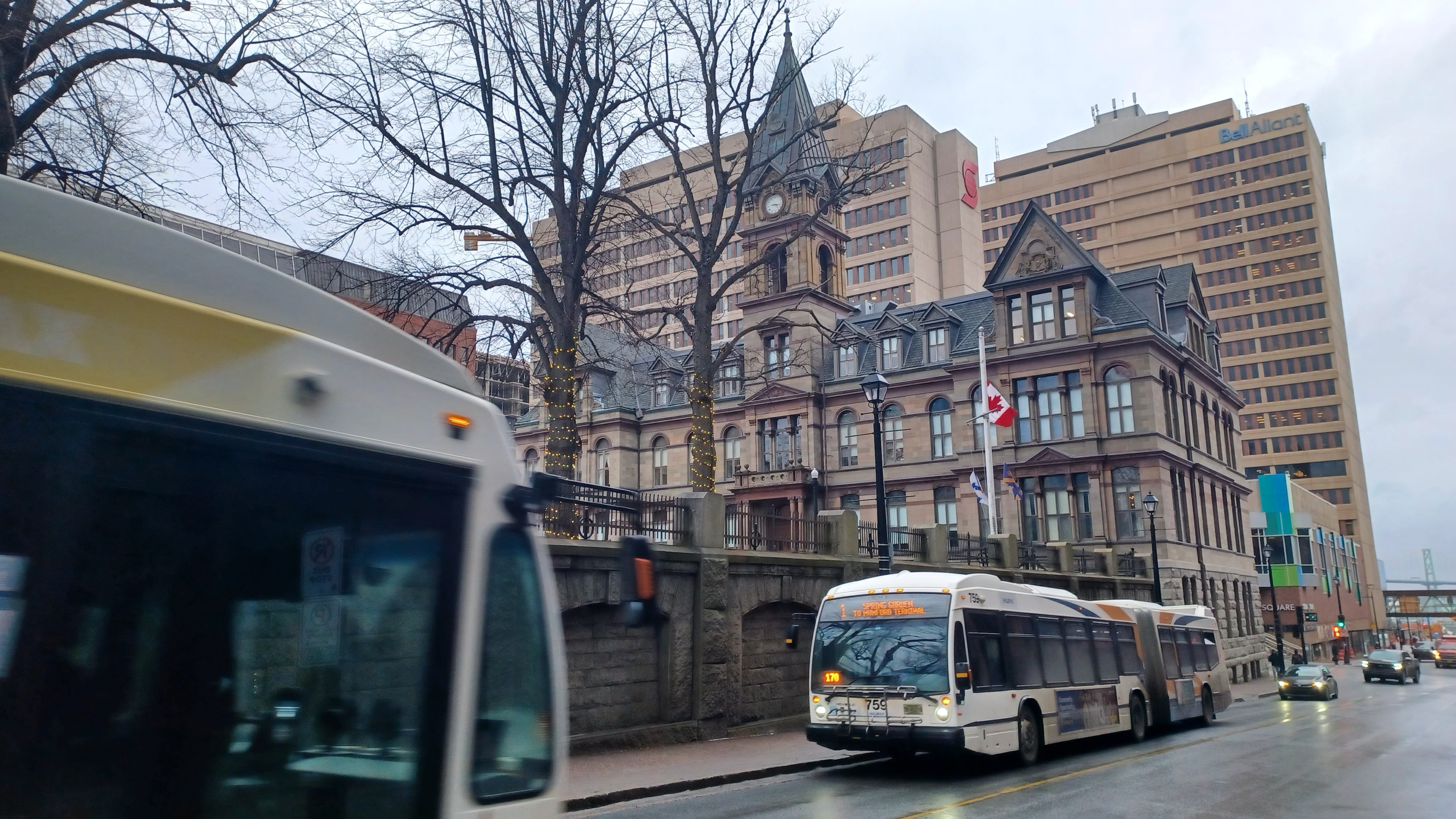
by Giancarlo Cininni & Antonia Zwissler
Last week, city hall was no stranger to controversy. During public feedback at a Feb. 11 budget meeting Urchin Property Management Inc. owner Ursula Eckoldt let slip that she has a second home in Europe while bellyaching about how high taxes hurt “mom and pop” landlords. Much more boring, yet more important, transit planning was also on the agenda.
Executive director of Halifax Transit Robin Gerus presented Halifax Transit’s $66.5m 2026/27 draft budget, which costs $158m but makes up $91.6m in revenue. Four new Access-A-Busses and eight operators are to be delayed until a service review is done this year. Transit also wants to hire two electricians to repair electric bus infrastructure. Another upgrade is the 320 airport bus becoming the first 24h route in Halifax, planned for next year. And Mayor Andy Fillmore marvelled when Halifax Transit’s Mark Santilli said bank card tap and pay could be here by summer.
Many of the upcoming changes fall under a new three-year plan called the Core Service Plan (CSP). It could cost $70m between now and 2029. Much of the plan is designed to bolster transit between the HRM’s growing suburbs “We are seeing a lot more jobs and people choosing to live in the suburbs,” said Halifax Transit planning technician Reuben Walker.
This year, the plan adjusts four routes, including running the 5 more on Sundays. Next year, 21 routes would be expanded, and 20 busses added. The third year adds 10 busses and expands four routes, including the 54 and 55 to Port Wallace which would only expand once Port Wallace is denser. Furthermore, microtransit, an on-demand service that relies on smaller vehicles, is also on the way.
The Winners
Jean St. Amand (District 16) won the CSP lottery. His district is slated for a new north-south bus route, the 95. The plan also cuts Cobequid Terminal out of the 92 route, ending in West Bedford instead.
Robin Gerus, Transit ED has kept his job for a year, and hasn’t made council uncomfortable by asking for too much money. When considering Halifax’s $1.21b operating and $304m capital budgets, the $70m CSP is modest. It meekly asks for more aggressive improvements in a veritable footnote of the 110-page plan; improvements like 35-100 extra busses (for $10m-$30m annually) to get routes 1-10 running every 10-15 minutes. Or $2m-$10m for daily regular busses to the Burnside business district, instead of reduced weekend schedules. Bolder changes are expensive, and not officially recommended to the ascetic budget committee.
The CSP also exposes the nine lowest performing bus routes, including the 401, 415, and 433. Cutting these routes would save $4.5m, but weren’t recommended for those three lines because no other busses run there. Halifax Transit’s Patricia Hughes told council cutting routes that aren’t used much disproportionately decreases ridership. Riders see the bus as less reliable, or may have to drive sometimes and fully switch to driving. So riders of the 401, 415, and 433 are winners too, for now.
John Young (D14) had a win with Lucasville being chosen for a microtransit pilot, because it’s close to Sackville Terminal and relatively small. The pilot would start in 2027 at the earliest. At the Feb. 9 Transportation Standing Committee meeting Young defended Lucasville from other councillors hungry for more transit. “There is a lot of, why just Lucasville as a pilot?” he said. “Currently Lucasville is without transit, there are no sidewalks, near road shoulders […] It’s a historical Black community that is 199 years old and still without the service.”
The Losers
Billy Gillis (D15) was disappointed Beaver Bank didn’t get the microtransit pilot. “We have two fulltime filmsets out there now, plus a senior’s home with a CCA training program that advertises its jobs saying ‘you must have a car to commute.’” Gillis pointed out Beaver Bank once had the oldest transit service in the HRM, but lost it in 2019. However, the 8 will run every 15 minutes at peak weekday times.
Cathy Deagle-Gammon (D1) was snubbed by both the CSP and microtransit. “It’s good for everyone except those who live in Fall River,” she said. The option to reroute the 320 to Fall River was rejected, and it isn’t getting the microtransit pilot although it was almost neck and neck with Lucasville for need.
Nancy Hartling (D13) tied last with Deagle-Gammon as St Margaret’s Bay and Prospect didn’t get much, the creation of the 21b branch route which will serve Marketway Lane area was meagre consolation. “If I could follow Gammon’s profound disappointment, if you are in St Margarets Bay this represents a letdown,” she said. “Even if I look at the Microtransit this plan doesn’t represent Prospect at all.”
But the grinding wheels of bureaucracy won’t stop here. Whether or not any of these plans get approved, will have to be decided at a later date at Regional Council some time in March.
Council steers city towards bankruptcy
by Matt Stickland
Last year, during budget season, the city’s chief financial officer, Jerry Blackwood, warned council that the city was well into a trajectory of fiscal decline. He was responding to a comment from councillor Trish Purdy (D4:-$5m/yr) who was implying council can keep asking for cuts and staff will always manage to figure it out; pull a rabbit out of the hat, as it were. In response, Blackwood warned that “staff always pulls a rabbit out of the hat or does something—that’s not a way that we should be doing budgets; like at the end going into reserves, going into one-time funding, like, we are running out of options.”
And even though everyone on council presents as adults too old to believe in magic, at the end of Friday’s budget meeting councillor Shawn Cleary (D9:$28m/yr) asked staff for yet another rabbit.
During the fall pre-season budget debates, mayor Andy Fillmore asked staff to keep the tax rate flat this year. In response staff said that the city was growing and council had already approved some things like new firefighters, which a strict flat tax rate would eliminate.
So council relented and instructed staff to do a flat tax after including the already approved by council spending. Practically speaking a flat tax this year means finding $40 million in cuts or new revenue.
And so, following council’s instructions, staff came up with $40 million in cuts and included them as options in this year’s budget. Things like stopping transit at 10pm, forgoing maintenance to let roads degrade, and not funding Halifax’s climate change resilience plan know as HalifACT.
These cuts are (unsurprisingly) unpopular, so no councillors have included them in the budget, which means the tax rate will go up.
The tax rate going up is unpopular thanks, in part, to a special interest group called “Stop the Property Tax Hike” spending $27,585 on Meta ads. And Kevin Russell, the Executive Director formerly of the Investment Property Owners of Nova Scotia, which has now rebranded itself to the Rental Housing Providers Nova Scotia, presented Budget Committee with a survey of thousands of respondents asking for lower taxes. Russell did not mention in his presentation to council whether the survey asked if people wanted city services, which are paid for by property taxes.
Nevertheless, at the end of Friday’s budget meeting, after all the unpopular cuts were rejected, councillor Cleary put forward a motion asking staff to come up with a new set of cuts, or maybe the same set of cuts, but either way, the motion asks staff to find yet another rabbit to pull out of a hat.
Hopefully, the next set of cuts will also be unpopular and be rejected by council, because the fact of the matter is that the majority of Halifax’s districts run a shortfall every year, and it’s impossible to cut our way to sustainability when over half of the city’s districts are themselves unsustainable. That math is why the city is on the path to bankruptcy in two major ways.
The first, is that the majority of districts are unsustainable, which means a majority of councillors (and the mayor, if we assume his political incentives lie with the majority) win their power by looting the surpluses of downtown to subsidize their residents. Every single vote in council chambers, if done for strictly political reasons, would be a vote 10-7 for unsustainability. Every time. The good news is that some councillors, like Janet Steele (D12:-$2m/yr), sometimes vote for the best interests of their city rather than exclusively for their residents who want to keep downtown’s subsidies flowing to their suburban and rural money pits.
And constituents don’t always have the best grasp on how city finances work, for example, a surprisingly large number of otherwise intelligent people believe that motor vehicle registration fees collected and spent by the province completely cover the costs of the city’s road budget. And sometimes, otherwise intelligent councillors have similar blind spots, for example Billy Gillis (D15:-$15m/yr) in a debate about bike lanes wanted to know why bike lanes were paid out of the general rate, and not by the downtown districts who primarily benefit from them. And the answer is that downtown District 7 and its $86 million annual surplus could pay for the entire bike lane network this year and still have $41 million to kick into the general tax rate pot. But District 7 can’t use its surplus to fund the bike lane network because it must cover District 15’s annual operational deficit.
Besides the politics, the other half of the reason Halifax is headed for bankruptcy is that it’s impossible to cut our way to sustainability when the majority of Halifax’s districts run an annual deficit. But that is unlikely to stop our council, who by a structural majority, are more than happy to keep trying to do the impossible until reality catches up with us and the city gets a public trustee appointed to manage our finances because council hasn’t.
The Other Stuff
Book club, Sunday, March 1st at Celtic Corner. Will we see you there?
New episode of the podcast is out, and only half of it is a fever dream.
Doing the crossword at home? Here’s the pdf of the paper.

How’d you do on last week’s puzzle? Here is the answer.