Where the sidewalk ends

No improvements to life-threatening sidewalk
by Jenna McConnell and Antonia Zwissler
“Nobody drives 60 here,” said Elgin Marko standing in her driveway, 20m away from a Maximum 60 sign.
In October last year, she had a close call trying to pull into the driveway.
She was in her Mazda 3, when she saw a truck and trailer barreling toward her.
“They were on my tail in no time.” Elgin’s tone is measured, her eyes hidden by gold-rimmed sunglasses. She had to swerve into the next lane to get out of the way. Her small car “does not have the power to outrun anything bigger.”
“I almost got completely, unrecognizably crushed in front of my house, and my teenager would’ve walked out and seen that. Not good.”
Despite frequent driveway close calls, Elgin and her family might actually be safer in a car than they would be taking the bus.
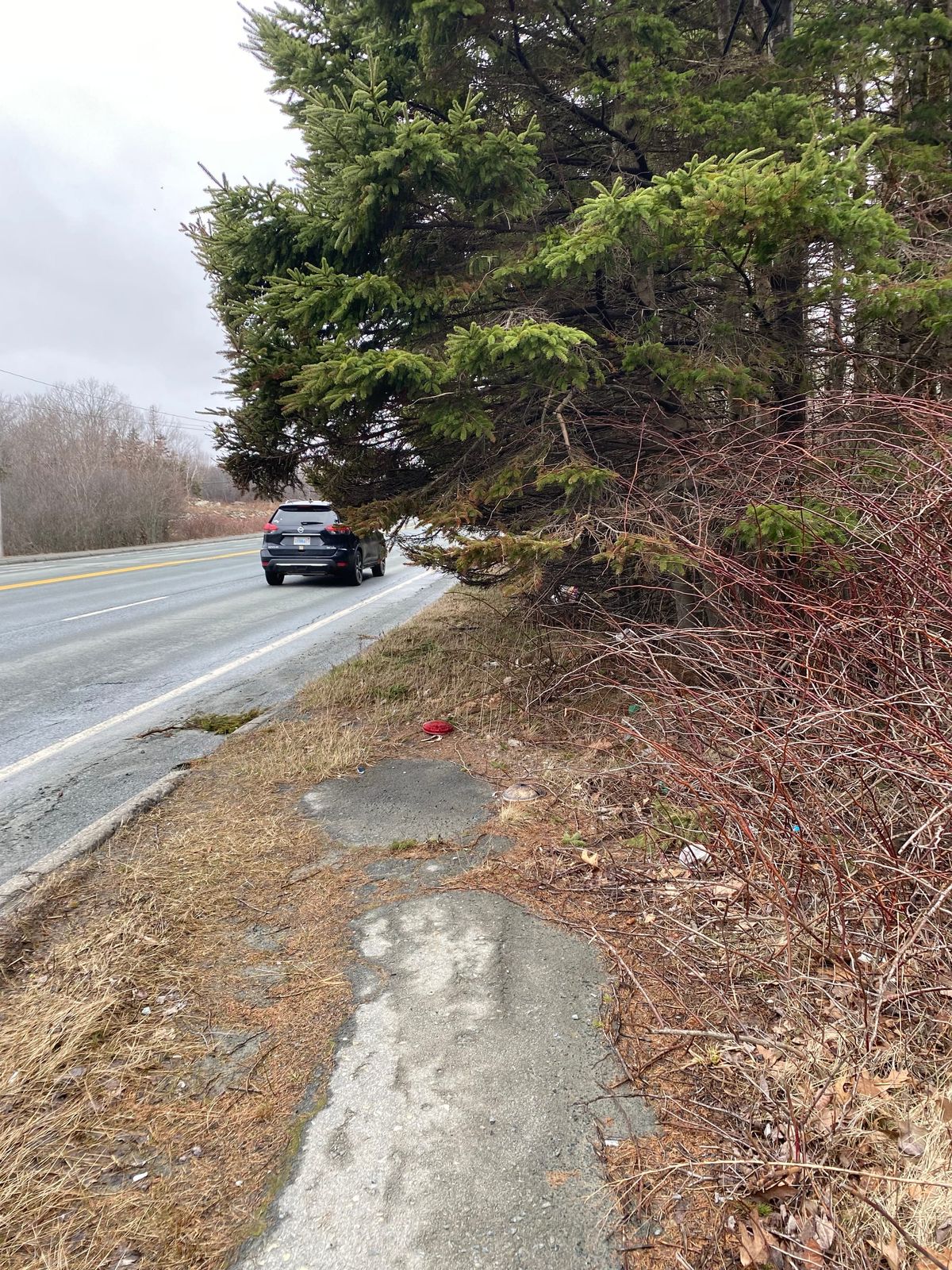
A year after Grand Parade first spoke to Elgin and her daughter Maddie Marko about the most dangerous bus stop in Halifax, nothing has changed. The road leading from her house to the nearest bus stop has no sidewalk.
Trees poke into what little space there is to shuffle down to the stop.
What little sidewalk there is still isn’t cleared in the winter, but the road is being cleared, filling the small shoulder with snow.
Maddie is 24 and graduating college this year. She takes the bus at least five days a week, and has to walk the dangerous stretch twice on those days. She says her siblings use the bus about half as often.
With three siblings, that adds up to about 8,030 annual walks of this stretch, risking injury or worse.
Elgin tries to prevent her youngest son from taking the bus to due the danger of getting to the bus stop.
She drives him around as much as she can, even though he’s 17 and would rather have some independence and take the bus. As the only driver in the household, Elgin is the one who takes her kids to important appointments. She said she drives 80-100km a day; other than her mortgage, her vehicle is her most costly expense.
Elgin reached out to her councillor, District 4’s Trish Purdy, in January 2025, and said she invited Purdy to walk up the road together so Purdy could see why the sidewalk/snowclearing issue couldn’t wait another season to be solved.
Purdy didn’t take her up on the offer.
A whole year came and went with no improvements.
“I gather she has desire to do something but zero skills and competence,” said Elgin. She added that she doesn’t understand why councillors don’t need any training. “When you work at Tim Hortons you need training, why not for government?”
Councillors get a crash course on municipal government after winning the election. Purdy, on her second term, has done this training twice.
Purdy was unavailable for comment before Grand Parade’s deadline.
In an email to Grand Parade, city comms staff wrote that there’s a conceptual plan for an upgrade of Main Street “intended to complete the missing sidewalk connection to the transit stop.” The Main Street upgrade is still in its planning stages and has no construction dates. Staff said this project would build off the Ross Road realignment project, which will cost $3.8 million this year. The Ross Road realignment is meant to improve pedestrian infrastructure at its intersection with Main Street on the Markos’ block. Construction on Ross Road is expected to go from late 2026 to 2028. According to HRM’s 2026/2027 capital budget the “project responds to safety and operational issues at the intersection.”
Elgin’s property taxes include an annual transit access fee of about $300. This is $300 she pays to have a bus stop that’s only accessible by walking in a car lane of the 107 highway.
In the fall, Elgin Marko saw a three-vehicle crash near her home, saw people being taken away in an ambulance. After that, there was speed policing for a while. Speed policing “always helps,” Elgin said. “It cuts down the ones that want to go 100, and 120, and takes them down to 80.” With an adventurous edge to her voice, Elgin suggested making it a 30 zone, because then those going 80 would be at the stunting limit, and 80 would be “sort of” manageable–“if there weren’t humans walking in the traffic lane.”
Maddie seemed hesitant to say whether things would ever get better, describing the situation as an “uphill battle.”
“I don’t think it’s particularly acceptable to allow some houses to just not have access to public transit without-” Maddie paused, choosing her words carefully. “Without going through less than safe conditions.” Her mother has thought of trimming the brush along the road herself, but Maddie is worried about legal ramifications since it’s not their land. Maddie’s considered making a petition to try and spur some action, but she doesn’t know if it would work.
Her mother is even less optimistic about things improving. “We are acquiring a larger wardrobe of hunter orange wear.”
Kids may get agency in city planning
by Matt Stickland
Halifax has a problem with its transportation plans, or staff, or both. And this problem get thrown into sharp relief anytime council asks staff to plan for anything other than car first transportation.
At last Thursday’s Transportation Standing Committee meeting District 9 councillor Shawn Cleary brought forward a staff report about including young people in transportation planning.
Cleary first asked for this report almost a year ago, after a presentation from the organizers of Kidical Mass Halifax (which is part of an international movement advocating for child-and-cycling-friendly cities).
The theory goes that since Halifax is creating an All Ages and Abilities bike network, the city should get feedback from people of all ages to see if the city’s bike network meets its baseline accessibility targets of “all ages” and “all abilities.”
The bad news is that Halifax passed an Integrated Mobility Plan (IMP) almost a decade ago, which, in theory, has already instructed staff to include the needs of the city’s young non-drivers into their transportation planning.
This type of high-level integration of mobility planning has not happened in spite of the IMP passing almost a decade ago, which has further perpetuated the inequities of our transportation system. Specifically, the delay makes it so people too young to qualify for a drivers license are more dependent and less safe when they travel, instead subsidizing car travel. So council included “equity” as a planning pillar in the new IMP update.
In theory, a city that has an Integrated Mobility Plan with a focus on equity would automatically plan for and seek feedback from young non-car transportation network users.
In practice, councillor Shawn Cleary instructed staff to come up with ways to include youth feedback in transportation planning, depending on the available budget.
Nothing says equitable transportation planning like cutting youth input due to budget shortfalls caused by driving subsidies.
Transit staff hide poor performance in Q3 KPI report
by Matt Stickland
In the year 2018 Halifax Transit was in dire need of improvement, so the city passed the Rapid Transit Strategy which aimed to speed up and make bus transit in Halifax more reliable. In the eight years since council approved the Rapid Transit Strategy busses in Halifax have only gotten slower and less reliable. But it’s very hard to tell from the data that transit is slowing down and becoming worse because Halifax Transit tracks it’s own performance and simply removes metrics that make them look bad.
Take for example the ferry stats in Halifax Transit’s third quarter Key Performance Indicators (KPI) as presented to the Transportation Standing Committee last Thursday.
Halifax’s ferry service never competes with car congestion, always has a spot to dock, and long windows to dock, unload passengers, load up again and steam back across the harbour. As a result Halifax Transit staff report that the ferry has a 100% on-time performance.
However, due to needed repairs the ferries sometimes had to be pulled from service and didn’t make their scheduled trip across the harbour. Now, if you were publicly educated in Canada you may remember your time in school when if you didn’t do an assignment, you got a big fat zero and not handing in your assignment counted against your grade when it came to report cards.
If Halifax Transit staff were held to the same performance standards as highschool students doing homework, then the ferries only had a 98.8% on time performance. In the next quarter, with a few ferries out for maintenance for as long as a year, the ferries on-time performance is likely to bottom out at being on time about 75% of the time.
One of the other ways transit staff hide their failures is by moving on-time standards to reflect how much busses get caught in congestion.
To be fair, if a bus scheduled for 8:30 consistently shows up at 8:40, it’s better to change the posted time than to knowingly ask transit riders to waste 10 minutes of their one and only life on this earth waiting for a bus the city knows is going to be 10 minutes late.
But when reporting on-time performance to council, staff detail how reliably that 8:30 bus arrived 10 minutes late. If the 8:30 bus had its schedule rewritten to bake in congestion delays and now reliably arrives between 8:37 and 8:41 then staff report to council that the 8:30 bus is on time.
Like ferries, if a bus is cancelled, that doesn’t count against on-time performance.
The Other Stuff
There's a podcast, the link didn't embed properly last time and I don't know why. But it's probably for the best because I screwed up and got some stuff wrong in the segment about Fillmore's travel to Boston. The TL;DR is that the tax payer did not pay for his travel and he travelled alone. For the full correction, listen to this week's episode below.
Here is the paper for your printer if you are doing the crossword at home!
And wouldn't you know it, here is the answer to last week's puzzle!