School librarians in HRM still at risk of being cut


by Jenna McConnell
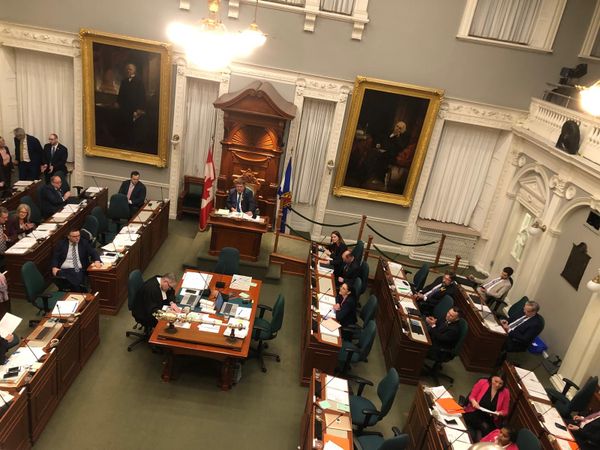
School librarians in the HRM face being abruptly fired as negotiations between council and Halifax Regional Centre for Education (HRCE) about the future of the librarians’ funding continue.
The HRCE employs between 75 and 100 librarians, or library support specialists, in its schools. They are paid through the Halifax Regional Municipality’s supplementary education fund, which was nearly $13 million this past school year. The library program gets about $2.5 million of that total funding.
Some affected librarians found out about the potential cut from a Facebook post of minister of education and early childhood development Brendan Maguire.
Cheryl Chambers has been a school librarian for 18 years now.
“You feel good about what you do,” Chambers says. “You’re helping give a safe place to students who are obviously in need of it. Teachers change each term, but I’m there all the time.”
Her duties in the school go much further than simply shelving books. Chambers also handles the maintenance of all the school’s laptops. She helps students with printing résumés, university applications, and she even runs the school’s Duke of Edinburgh program.
Chambers found out about her position getting axed by council at the same time as the public, through the Facebook post on social media by Maguire. This post appears to have been deleted since. Grand Parade reached out to Maguire for comment, but did not receive a reply in time for publication.
Screenshots of Maguire’s post cite public libraries as a sufficient replacement for school libraries, saying students who wish to read can just go to a public library instead.
The first rumours of potential cuts to the school library program came about back in March. This means that employees like Chambers have been unsure whether they will lose their jobs for a full month. There has been no official statement by the HRM or HRCE on the matter, making it hard to know what exactly is happening behind closed doors.
“It’s definitely a real threat,” Chambers said. “We’ve been told that we should know very soon, but it’s been well over a month.”
The secrecy is a function of city policy. Contract negotiations are done in camera and the jobs of librarians depend on whether the province and the city negotiate a new memorandum of understanding that includes HRCE librarian funding in property taxes.
Chambers, discouraged and frustrated, says she does not think that council will completely axe the program, but there is no way to truly know.
Kristin Welbourn is a school librarian similarly vexed by the situation. She works in Bay View High School’s library and also has no idea whether her job will continue. She helps up to 500 students in a day, and reads hundreds of YA books in her spare time to stay in touch. She also reads hundreds of book reviews and browses library forums to ensure that every type of student will find something to read in her space; “if you’re interested in hockey or if you’re part of the LGBTQ community, I’m gonna find you a book.”
“This is my life’s work,” Welbourn said. “I care about students. I care about their literacy. I care that they’re critical thinkers.”
She is also frustrated by the governments’ silence and general lack of information on the matter. She absolutely loves her job and students and is sad to see this happening.
“School librarians raise literacy rates between 15 and 20%,” Welbourn explained. “We don’t want to see our literacy rates drop by that. And that will definitely happen. We also raised graduation rates by up to 20%. We don’t want less people graduating from high school.”
It is uncertain whether school library programs will be cut completely, or whether funding will simply decrease. Chambers hopes the government will recognize the importance of her position in students’ lives.
Welbourn, however, is more fearful.
“It’s so sad. We will end up with less critical thinkers, people who are not able to look at media posts and news posts and be able to discern which is fake and which is not. And that’s not OK in this society. We need those things for our kids.”
She urges students, parents, or anyone else upset by this potential decision to reach out to their MLAs and councillors.
It is unknown when a decision to cut or save the librarian funding will be made. Many students use their school libraries, which offer much more than just books to read. For some, it is the only safe place they have where they can truly be themselves. For others, it is their only place to get a book or magazine, or to use the computer. Librarians like Welbourn and Chambers are vital to students and their schools as well as the surrounding community, and their removal would be devastating for everyone.
Integrated Mobility Plan updated
by Matt Stickland
Almost 10 years after it was first implemented Halifax’s Integrated Mobility Plan (IMP) was showing it’s age and needed a bit of modernization.
Back when it was passed in 2017 the IMP was the city’s bold plan for reducing congestion. A large part of the plans inability to affect positive change on the city’s congestion was that Halifax’s bureaucracy needed to fundamentally change how it thought about, planned, and built the city’s transportation corridors.
And on top of needing a new way of thinking Halifax experienced massive population growth and a pandemic, both of which had profound detrimental impacts on the city’s transportation network.
As a result, staff reworked the IMP into a more concise, actionable plan for council and the city to follow. Staff told council that most of this new plan’s actions are “considered follow-up to an original action and reflect our 2026 understanding of how best to meet IMP objectives.”
One of the big changes in the new IMP is the inclusion of equity as a goal of our transportation system.
This IMP update is extremely controversial for some like District 4 councillor Trish Purdy who said that council needed “to be honest about what the impact has been” of the IMP.
She then continued to say that the city was “losing parking at a great rate with these new street designs,” and that “ we are losing street capacity, which leads to greater amounts of congestion.”
According to An Ecosystem Approach to Reducing Congestion study in 2018 from the National Parking Association removing parking and car capacity on streets both reduce a city’s congestion.
She also said, “We have received IMP treatment in District 4, and it has not resulted in improvements to street flow or pedestrian safety from the comments that I’ve received.”
According to city crash data, before Cole Harbour got the IMP treatment, Forrest Hills Parkway averaged 0.75 pedestrians being hit a year. Since getting the IMP treatment, the average has dropped to 0.5 pedestrians being hit a year.
AG finds off-book Halifax Water hires
by Matt Stickland
Halifax’s Auditor General found that Halifax Water is not following its hiring procedures.
At last Wednesday’s Audit and Finance standing committee was, Halifax’s auditor general Andrew Atherton presented his report about Halifax Water’s hiring practices. In it he highlighted that some candidates who had been hired or short-listed were selected without any supporting documentation as to why. In four cases Atherton’s team found that non-union jobs were posted internally for no apparent reason.
“That’s a pattern you’ll hear a lot,” Atherton told the committee of the Halifax Water audit. “Frankly, I’m hearing it a lot in a lot of our audits. It’s the documentation of what’s happening that’s missing.”
Atherton told the committee that often when his team asked for more information, Halifax Water staff were able to find it, but not always. His report identified the missing documentation as a risk because, without the paperwork to explain why someone was hired, it’s impossible to prove that no wrongdoing occurred. He explained that his report was in no way saying Halifax Water hired the wrong people or hired people inappropriately. This report was just to find out if inappropriate hiring could go undetected. And, unfortunately, a small but annoyingly consistent percentage of hiring decisions are made without anyone writing down why these decisions were being made.
Councillor Kathryn Morse wanted to drill down into any potential malfeasance asking “do you have any details about the positions for which people were hired and there wasn’t a lot of documentation, what types of positions were those?”
The AG told Morse he was not comfortable getting into that level of detail because anyone hired without proper documentation “may be doing an amazing job, they may be the best candidate ever, it just wasn’t properly documented when they were hired.”
The concern is if someone is not property documented, and if documentation is consistently missing, and if those documents are always missing when Halifax Water is hiring for a specific department, that may be a warning of corruption at Halifax Water.
Not to discount the possibility, but the institutional risk posed by lack of documentation cuts both ways.
If someone who had the CV of the “best candidate ever” applied to Halifax water while pregnant and was not hired, without documentation to explain why Halifax Water did not think the applicant was the best candidate ever, they also wouldn’t be able to prove she wasn’t given the job because she was pregnant.
The Other Stuff
Book club has a new time because a kids hockey schedule was late to be updated. We are now meeting at 3:30, not the former time, which I will not mention to avoid confusion in your future vague memories of this email. Still at the Old Triangle in Halifax, still reading The Score: How to stop playing someone else's game by C. Thi Nguyen.
There is a new podcast out this week, you can find it wherever you get your podcasts.
Doing the crossword at home? Here is the pdf for your printer!
How did you do on last week's puzzle? Here is the answer!