Allan St diverter divides community
Pylon piled on pylon pile on pylon pile up
by Katy Jean
Across the globe, all the time, at any minute, there are battles happening on as many roads as there are maps labelling them.
Drivers are fighting drivers. Drivers are fighting cyclists. Drivers are fighting pedestrians just making their way with two feet and a heartbeat.
Every city has their main arteries full of loud horns and pollution billowing out of the top of the street’s food chain, car drivers.
In the West End of Halifax, the battle has escalated.
At the intersection of Harvard and Allan Streets, there is war.
At first glance, the intersection is quiet. Residential. Old dogs strut down the sidewalk, flashing the whites of their eyes, checking in with their owners every few cracks in the concrete. Babies have the time of their lives floating along in their comfortable strollers, forming early memories of home.
Neither of them notices the casualties, the cannon fodder in the street.
At the end of February, the intersection was a site of carnage.
A series of pylons acting as the front line against drivers’ war on safety had lost. Their remains were fractured and fragmented down Allan nearly reaching Oxford Street.
The guerrilla pylon army had been deployed upon the tactical withdrawal of flexible posts, once posted in the middle of the Allan Street barricade/modal filter installed in November 2025.
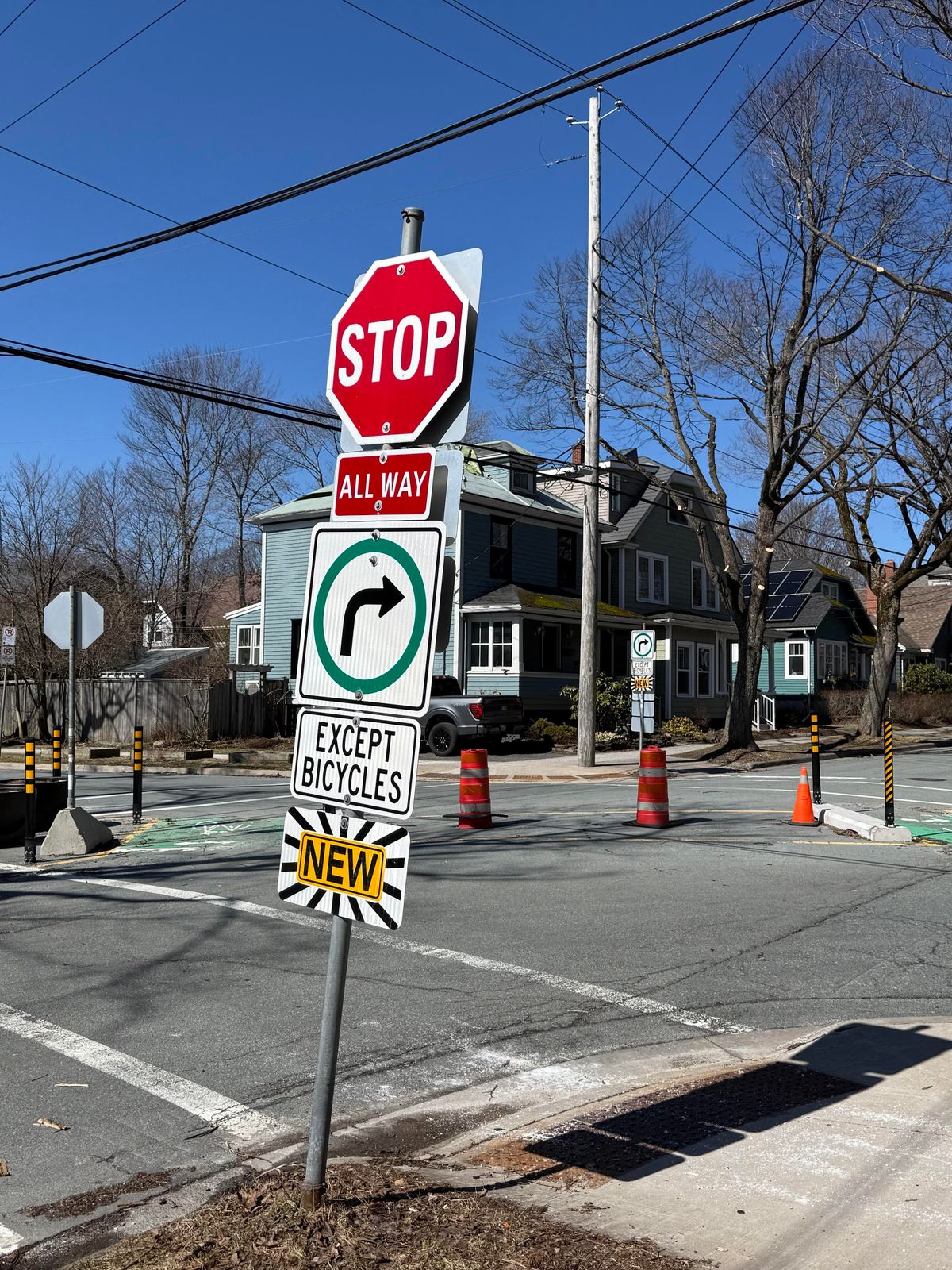
The barricade’s intention was to create a bikeway and also to disrupt drivers cutting through Harvard and its side streets to avoid the car-clogged Quinpool, Chebucto, and Windsor.
Effectively, it cut Harvard in half. If you are driving from Quinpool, you must turn right onto Allan, and drivers from Chebucto must turn right onto Oak and vice versa.
Pedestrian and cyclist routes are unaffected. Or rather, protected.
In the afternoons in the last bit of February and a bit of March, the number of walking through the intersection was nearly equal to the number of people driving. About 40 every 15 minutes.
Most drivers are the vehicle’s single occupant.
The barricade’s flexible posts allowed emergency vehicles to drive directly through the intersection with minimal damage. Which was a direct answer to a Supreme Court case filed by local residents attempting to prevent the barricade from being built.
And court is where the Pylon War began.
In May 2018, the plan for the bikeways and diverter barricade was approved by the Halifax and West Community Council. As was the end of Allan Street becoming an extension of, and thus renamed, Oak Street.
In August 2018, 20 residents from Harvard, Allan, and neighbouring Lawrence Street, who are publicly named in court documents, took the city to court to stop it all.
The residents raised concerns that the barricade would slow emergency vehicle response times, lengthen their own travel times, and add congestion to their roads.
While the court case was happening, the city went on with plans for other surrounding traffic changes, such as redirection at Allan and Oxford Streets, where you must turn and not cut across to Oak, and are not allowed to race adjacent to the wild west that is Quinpool Road.
The residents also stated that they were not adequately alerted of these changes. That the city didn’t directly address or consult them.
The city had sent out postcards to residents and had given out surveys on the issues, as well as marketing online and in newspapers.
In the survey, 33% of respondents were not concerned about the diverter, 17% were somewhat concerned, 25% were very concerned and 25% left it blank.
The court did find in May 2023 that the city had done their due diligence and the case was decided in the favour of the city.
All was quiet on the intersection front. Except for the enthused cyclists and pedestrians celebrating the win.
Until the summer of 2025.
Laser-printed posters began popping up on lamp posts on the streets surrounding the intersection. Some still survive in various shapes to this day. In large font, they were titled TENANTS and underneath, PLEASE READ.
The poster explained that only property owners were invited to give their opinion on the diverter but not people renting the homes. It urged tenants of the area to call councillor Shawn Cleary or mayor Andy Fillmore to have their opinions heard.
Not long after, secondary posters printed in ink appeared underneath the anti-bikeway propaganda. They did not fare as well against the weather. But they protested the anti-barricade opinions and took their stance as pro-bikeway and pro-pedestrian.
The pro-bikeway posters were quickly found torn down.
And by the time the concrete started to be poured in November, the posters were all but gone, with an illegible few still stapled around the blocks.
The Facebook group Our Chebucto Neighbourhood began to heat up.
People were mad. People didn’t care. People were mad that people didn’t care, and people didn’t care that people were mad.
One photo of the diverter being started has 72 comments. Some comments have higher word counts than this page. One reads: “Amazing news. Finally reasonable fact based progress in this town.” which has the reply “sorry no this is pushing ideology. This will not help the traffic situation in the city or even this neighbourhood.”
The reply person was asked to elaborate on that comment. They did not.
Another comment says “What has happened to our city? Wow! And the city want more taxes? This is Ridiculous!!!!!! I feel like im living in the twilight zone lately.”
Utter disbelief at the concept of change. Change is something Haligonians tend to shy away from.
After the completion of the hot topic diverter, the snow fell. And a hole, or lack thereof, was found in the city plan.
Snow plows.
The middle flexible diverters and the length of the concrete ones did not allow for a snow plow.
Instead of creating a snow bank literally dividing the street, or you know, having someone physically shovel the snow, the flexible posts were removed for snow-clearing purposes around January 2026.
Immediately, drivers started to ignore the 32, yes, thirty-two, one more than 31, road signs surrounding the diverter, and reclaimed Harvard as a drive-through street.
And that is when the pylons were deployed.
First it was a single pylon.
Just enough to deter a driver in such a way that an elephant fears a mouse.
Then it was three pylons.
Then the pylons were gone.
Then they were back.
Most thought the city was putting down the pylons.
Most thought they would just move the pylons.
But again and again the pylons would appear and disappear.
Up in the morning, gone by night.
Up at breakfast, biffed into the winter sun by supper.
The re-spawning pylons seemed like far too arduous of a task for the city to do. Not once has “pylon checker” been discussed in the Halifax budget. A seemingly infinite job with the amount of pylons strewn about the city.
But that’s how the pylons came to be.
It wasn’t the city. It is a cyclist. A local cyclist simply decided to move a few local pylons where the barriers once were.
On their daily commute they use the bikeway. If the pylons are moved, they move them back. If they are where they left them, they carry on.
Other locals have joined in straightening out the pylons.
Other locals have run them down with their cars.
Which is when the cyclist found bigger pylons at a construction site nearby.
They somehow, without being detected, even on the ring cam of a house, hauled two large cylindrical pylons from near Oxford Street to the intersection of Harvard and Allan.
Now the pylons could not be run down. The driver would have to stop their car, physically get out of their seat, move the pylons to the side, get back in and illegally drive through and ignore the, again 32, road signs saying they mustn’t go that way.
Or a resident within view of the intersection could move them.
Can move them. Does move them. Along with the drivers. Cyclists and pedestrians set them up. Residents and drivers knock them down.
Every. Single. Day.
The war seemed to be over on March 4 when the city pyloned off Quinpoolto deal with snow banks. And the borrowed pylons at the barricade disappeared.
Likely, the city noticed they had an unknown area cordoned off. With no idea they were manipulating a battlefield in a war waged both for and against them.
But somehow, some way, the next morning, the pylons were back.
And on March 8 the war escalated.
An extra pylon appeared next to the two larger pylons.
Along with a metal signpost, with four sharp pieces jutting from the top and a long handle.
Invisible at night, if a car did drive through, it would be wrecked.
Worse, if an ambulance tried to drive through, it could be damaged or wrecked.
This would prove the 20 residents who went to court, and all who agreed with them, correct in the worst possible way.
The metal was moved to the side and then onto a planter of the diverter within a day.
Not disposed of, still available. Hopefully never put back.
It’s unknown when or if the flexible diverters will be re-installed. But they will be in view of the remaining Allan Street, the part which was not thus named Oak Street.
The pylons will be retired when the flexible posts are re-instatlled.
And drivers will again be diverted.
The Other Stuff
There is normally a podcast, and this week, there technically is one too, but it’s not for you. It’s for a computer.
Doing the crossword at home? Here’s the pdf for your printer!
How’d you do on last week’s puzzle?