Grand Parade, a history

The grandest parade square east of Montreal
by Katy Jean
The Heart of Halifax.
A place to smoke joints before concerts.
A place for winded tourists who have just realized half the goddamn city is on a hill, and they’re still not at the top of it.
Grand Parade.
A multipurpose outdoor space for everything from encampments, to lie-ins, to protests, to riots. Flag-raisings and pocket beers. Home of the Ugliest Christmas Tree. The only tree to ever be more lit than a stumbling politician on a New Year stage in the same place.
Grand Parade isn’t the centre of Halifax. It is the centre of Haligonians. It’s where we show up. Meet up. Just rest for a sec after we leave the bars fucked up.
It’s not the heart of Halifax. It’s the belly button. The place where the city of Halifax connects to Halifax’s creators.
And that’s how it’s been since 1749.
Grand Parade first shows up in a survey of Halifax by Moses Harris in July of 1749.
The rectangle at the centre of the city is set to have a church on one side (St. Paul’s Anglican Church would be built in 1750) and a courthouse as well as a jail on the further side, with the “Parade” directly in the middle.
The original draft has the parade surrounded by four forts. The Citadel had yet to become the main fortress for Halifax’s military. The main fortress was at that time projected to be built on the land of Point Pleasant Park.
But when the military went to destroy the sacred Mi’kmaq land, they found it “too hard,” “too windy,” and “too cold.”
So they built the Citadel. Which arguably was “too hilly.” So they cut off the top to flatten it for the fortress. And then did it again later. Making Citadel Hill shorter by about 40 of its original feet.
St. Paul’s Anglican Church was the only real structure on Grand Parade for the first 45 years. And the grounds were used more for community services like meeting and buying and selling.
It wasn’t until 1794 that the Citadel started to get a makeover and become closer to what we see today. Not to be outdone, Grand Parade got repairs to match.
The Parade was still a part of the lugubrious, calf-burning, lung-busting hill that is Halifax.
The 1794 visit of Prince Edward, Queen Victoria’s dad, is when he had asked for and funded the renovation of the Citadel. And with the Citadel, the military would need a place to parade. In a grand way.
Grand Parade was levelled to the height we see now. The retaining walls that still stand where they were built 232 years ago hold up the carving into the hill.
And then in 1816, George Ramsay, Earl of Dalhousie, showed up.
Ramsay, born in a castle and into wealth, was a military man. He sometimes complained of walking too much into battle.
After missing the final Battle of Toulouse and retiring from the military, he sought to be appointed to the still cushy role of lieutenant governor of Nova Scotia. It’s where you go when you’ve done enough to earn some patronage.
He did such great tyrannical things as cut the number of escaped slaves getting rations in half by shipping the enslaved people to Sierra Leone or back to the United States saying “Slaves by habit and education, no longer working under the dread of the lash, their idea of freedom is idleness and they are therefore quite incapable of Industry.”
He also thought land should only be allowed to Mi’kmaq if they were to grow potatoes and become settlers. But their adherence to the Catholic religion made them “hopeless.”
A philanthropist, Ramsay, Earl of Dalhousie, would establish a school in 1818.
Dalhousie College.
Established in 1821 and quasi-opened to all creeds and religions (not women) in 1838, but super officially opened in 1863. Because that mattered to him. It also mattered that King’s College in Windsor was only open to Anglicans. He was
Presbyterian and found that unfair.
The Anglicans did not like that.
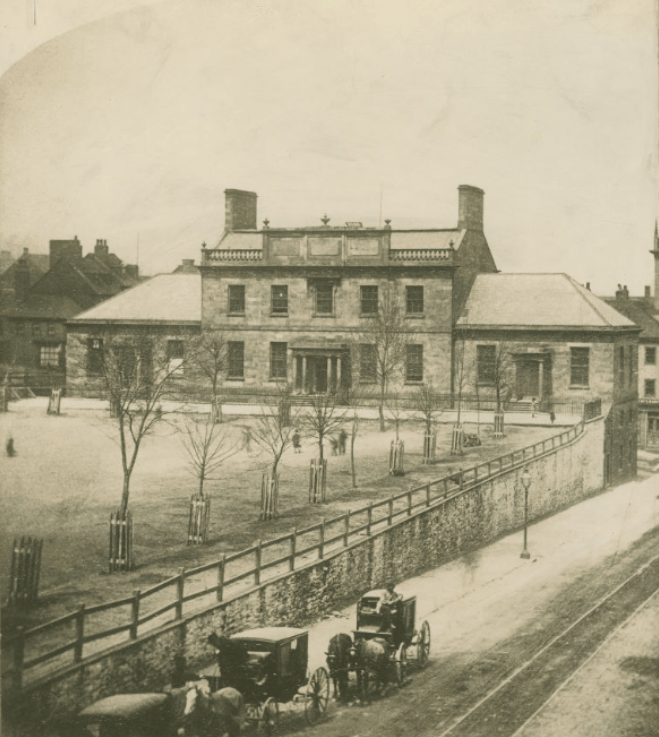
The first to-be-Dalhousie-University cornerstone was laid on May 22, 1820, on the north side of Grand Parade, a storey underground to allow more light into lower floors for classes and studying.
With full military and masonic honours to boot.
The large building, taking up most of the space East to West of the rectangle of Grand Parade, wouldn’t be done until 1824.
And then it sat empty for nearly 14 years.
Well, not entirely empty.
It was a hospital for the cholera epidemic of 1834 that killed 400.
And a bakery.
Then Dalhousie opened with twelve students and three professors in 1838.
Then Dalhousie closed in 1845.
But reopened in 1863 with overwhelming help from the public.Nova Scotia passed The Dalhousie Act at the same time, allowing universities to not require religious testing for admittance to a university, as which Dalhousie was now recognized.
By the 1870s, the building on Grand Parade and the parade itself were falling apart.
The parade’s fences from 1794 were falling down, the grounds were dirt and mud, and Grand Parade gained a reputation for being an ugly and dirty part of the city.
The Dalhousie building wasn’t doing much better and with the expansion of the law school and inclusion of women’s studies, the university needed more space.
At the same time, Halifax’s city hall on George Street was also falling apart.
Poor heating, poor roofing, and sewage that was known to back up and flood the basement had the city and alderman of the town seeking a new place for city hall.
The city had their eyes on Grand Parade.
But they couldn’t move in with the shape the grounds were in, and they asked Dalhousie to clean up the area.
The Earl of Dalhousie had deeded the school the land on Grand Parade in 1818, thus making the area Dalhousie’s responsibility.
Dalhousie said the repairs were too expensive for the school, which was barely scraping by and would need help from the city, which used it for civic purposes.
The city said they would help, but only if Dalhousie gave up the land, allowing them to build a new city hall.
Dalhousie said no.
Halifax then decided to build city hall on the south side of Grand Parade, directly in front of St. Paul’s church.
The church that had stood there for over 100 years, and for many of those years was the only one, its parishioners objected to a building blocking it.
Dalhousie at this time was expanding its law program. And soon they would get to test out their lawyers’ muscles as the argument over the land of Grand Parade and whose responsibility it was would go to the courts.
The negotiations and inclusion of judges lasted most of the 1870s, which led to greater deterioration of the Dalhousie building and the parade grounds.
By the end of 1879, the city dumped a large amount of granite in front of the Dalhousie Building, intended to be for city hall. Dalhousie University saw this as a threat and had their lawyers move at a faster pace to decide the fate of Grand Parade.
The case went to a jury in 1880, with the judge only able to convince half of them that the land belonged to Dalhousie.
The land was indeed deeded. Dalhousie had been using it for 70-some odd years. But Grand Parade was historically a civic space for Halifax. The surveys showed it, tradition kept it, almost everybody agreed it was the city’s residents’ area.
So Dal gave up.
There was no clear resolution.
So with a big pile of granite hanging out in Grand Parade and with mud up to their ankles, the City of Halifax made an offer.
The city would legally own Grand Parade, up to fifteen feet in front of the pavement of the Dalhousie Building.
Dalhousie could still use the building, as well as any workers, students, servants, horses etc. But the city owned Grand Parade (under agreement they could never sell it.)
The City of Halifax would also pay Dalhousie $500 a year, paid every June, as long as Dalhousie stayed within the limits of Halifax.
Halifax immediately went to work fixing up Grand Parade. New cast iron fence posts went up, the retaining wall was tended to, and the grounds were cleaned.
At this time Dalhousie needed to expand and fix their building.
The agreement left them unable to build another building on the Grand Parade site.
In 1886, it was decided by Dalhousie to give the entire land to the City of Halifax.
In return, Halifax gave them $25,000 and land in the city’s South End to build new buildings. Which they did.
The Dalhousie building was torn down, and the current city hall went to the planners’ plans.
When the granite from the pile finally went up, one thing remained.
The original cornerstone, laid in 1820 by the Earl of Dalhousie, became the cornerstone of city hall in 1887. It remains there today.
It was thought to rename Grand Parade as Victoria Square, as the parade had negative connotations throughout the city for being unclean and messy. This was decided against as it had always been called the parade, and that was most of the point of the decades-long battle for the beloved rectangle of Halifax.
Grand Parade has mostly looked the same since. A flag pole went up, cobblestone went down. A fountain used to be in the centre. It disappeared.
For a while, it was referred to as Grand Parkade, as much of city hall would park in the middle for sessions, or if you were lucky enough to find a parking space, you could park there for your daily excursions about the city.
The 2000s ended that. Cast iron bollards no longer allowed vehicles on the property.
But you can still park yourself on a bench and smoke a joint before a show.
The Other stuff
Did you know there is a podcast? This week host Matt Stickland sits down with Dr. Nick Ferenchak, the lead author of a study that looks into how driving itself is an inherently dangerous activity.
Here is the paper for your printer at home
How did you do on last week's puzzle? Here's the answer!