RCMP investigating Mayor
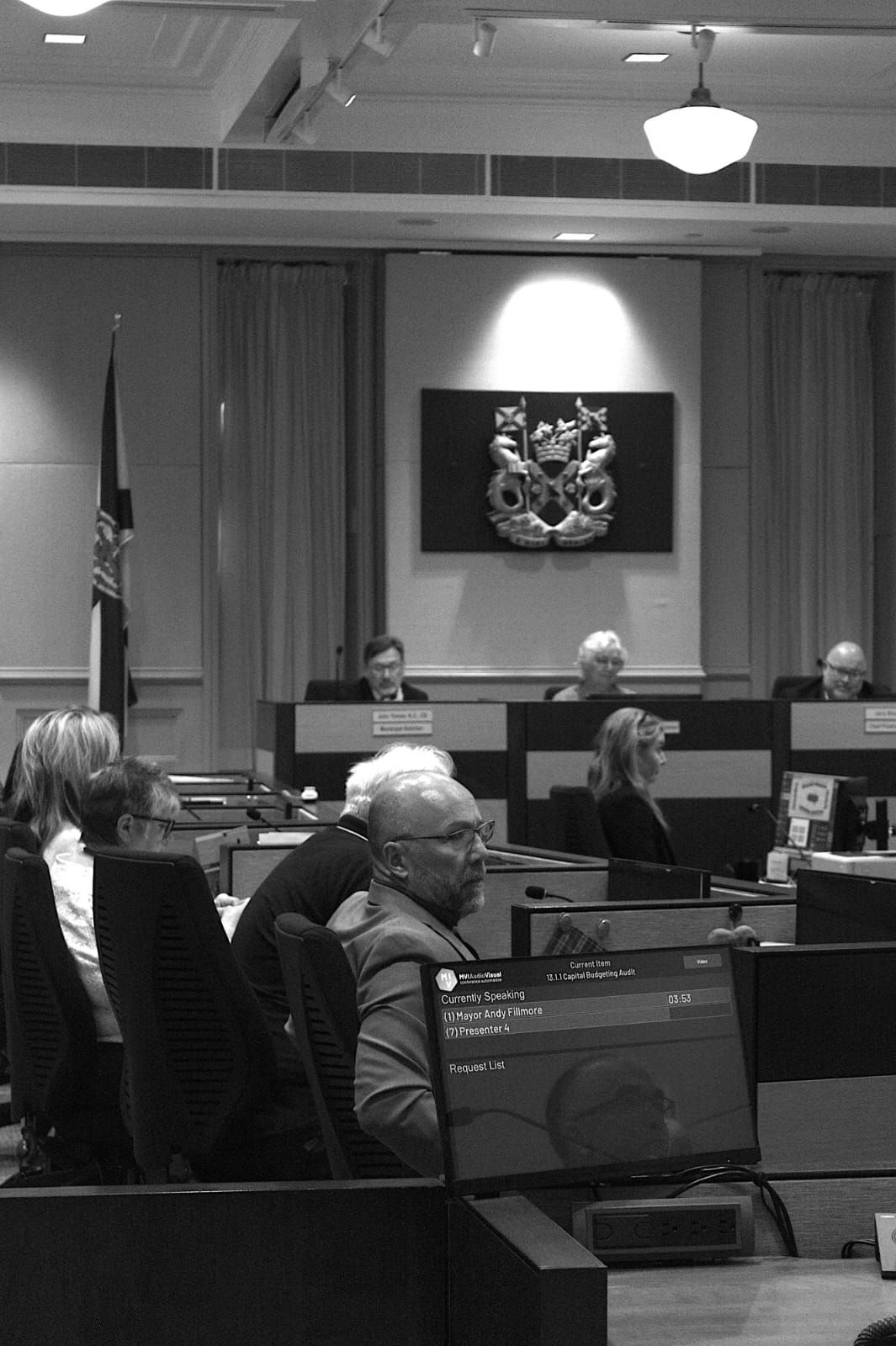
A timeline of the mayor’s sketchy spending
by Antonia Zwissler
HRM’s auditor general, Andrew Atherton, has sent an audit of four transactions from mayor Andy Fillmore’s office to be investigated by the RCMP.
The mayor’s office awarded its first dubious bid on May 9, 2025, to Scott McGaw’s Hawthorne Recruitment Inc. According to Atherton, talks around hiring a consultant began in late 2024, shortly into Fillmore’s term. Instead of going through the competitive bidding process usual for city work, there was no competition and the contract went straight to Hawthorne. The report Atherton presented at City Hall on June 22 says senior procurement staff didn’t agree with the favouritism displayed in the procurement process, but ultimately, the city’s chief financial officer, Jerry Blackwood and former chief administrative officer, Cathie O’Toole, signed off on it. Blackwood and O’Toole kept the contract secret, citing confidentiality concerns.
Atherton said confidentiality “just doesn’t fit in this situation, the work was to redesign job descriptions, assess the overall structure of the mayor’s office, and then to provide support during recruitment and hiring, none of that involves confidential information.”
In July 2025 (two months after the first Hawthorne contract) O’Toole announced her resignation. One month later, she announced the separation of the CAO’s office from the mayor’s office. In a memo, O’Toole flagged that the mayor’s office was projected to go over budget in spite of Fillmore’s office getting a $100k special projects transfusion to pay for consulting. Without the cash to pay for Hawthorne’s consulting Fillmore’s office would have been even more over budget.
The AG’s report last week noted the Hawthorne contract was initially supposed to run the city $50k, but ended up rising informally to $90k, instead of using a formal amendment to the contract. Acting CAO Brad Anguish was left to approve the bill after Hawthorne had completed the extra work. Atherton stressed that Anguish was correct to present the updated costs to the Audit and Finance Standing Committee in January this year.
This wasn’t the only financial free-for-all Anguish straightened out in January 2026. The second and third instances of non-compliant spending Atherton’s office audited also have their origins in 2025: two legal fees totalling $7,697. Fillmore said he incurred these fees when he hired lawyers to defend himself against the slew of code of conduct complaints he received that year. The mayor’s office does not have a budget for legal fees, so these need prior written approval from municipal solicitor John Traves. When a surprise bill for $1,425 arrived, Traves made what Atherton called “a one-time exception” and approved it. He sent an email back to Fillmore’s chief of staff, Joanne Macrae, informing her that proper policy requires his authorization before hiring a lawyer.
In November, Fillmore wanted to lawyer up against code of conduct complaints again, and Macrae wrote up a second unauthorized invoice, this time for $6,272. This one was billed as “other goods and services,” paid in December, and went unnoticed by senior management until early this year. Fillmore said this was because the drop-down menu for billing from his office doesn’t have a section for legal services, so that was the closest option.
Fillmore said “ultimately the CFO, the acting CAO, and the municipal solicitor came to me some months ago, when they, um, I think some routine accounting, maybe showed–listen, I don’t know how they discovered it, it was through some sort of accounting software, and had conversation with me about it, I immediately volunteered to repay the legal invoices.”
In Atherton’s version, “the acting CAO told the mayor that he needed to reimburse both amounts, and the mayor complied.” Traves said the two law firms Fillmore paid were Burchell Wickwire Bryson and Stewart McKelvey.
The fourth and final item from the Office of the Mayor Expenses Audit was a $14k speech writer Fillmore employed for his state of the municipality address. CFO Jerry Blackwood said the speech writer was Leo Artalejo. Things that cost the city more than $10k of your money need to go through the Procurement Office so there can be a competitive bidding process, unless there is an established vendor, in which case there still needs to be a contract. The mayor’s office reached out to the writer directly, with “no contract or statement of work in place,” according to the AG’s report, and payment taking the form of a cheque approved by Fillmore’s chief of staff Macrae. In the report, the AG writes: “Office of the Mayor staff said the supplier had been used by the previous mayor for similar work.”
In an email in February, the Lieutenant Governor’s office told Grand Parade that former mayor Mike Savage never hired a speech writer for the State of the Municipality address and only once used a speech writer when the host of an event he attended hired one for him.
Editor's note: There will be no paper next week due to Canada Day vacation.
AG blasts capital budget staff
by Matt Stickland
At last week’s Audit and Finance Standing Committee meeting Halifax’s auditor general (AG) Andrew Atherton dropped a bombshell audit much worse than the one which led to the mayor’s office being investigated by the RCMP.
The city’s capital budget has about $1.8 billion planned in spending over four years, with about $315 million being spent in both 2025 and 2026. This money is supposed to be spent on major infrastructure projects that help Halifax achieve its council-approved, democratically passed strategic plans.
But the AG found staff were not making capital budget recommendations based on council’s strategic plans, instead making siloed decisions about individual projects based on the needs and desires of individual departments.
The AG told the committee that when auditing to see how projects were selected for funding, “we just could not see how those decisions were being made.”
The city has a capital budget committee, which is supposed to coordinate city spending with city strategies, but the AG’s report found little evidence that the committee did “formal direction or oversight.”
The city does have a framework which instructs staff on how to prioritize municipal capital spending, but the AG’s report notes that “project prioritization was influenced by several judgement-based factors,” not the framework. The report also notes that staff did, however, use the evaluation framework “when budget constraints required projects to be delayed or removed.”
The AG also tested 12 capital projects from last year’s budget and “found differences in methodologies, approach to assumptions, level of detail, and documentation” in staff’s cost-estimating process. The AG also found “limited evidence of a formal quality review process for cost estimates.”
When the AG retested the six estimates with documentation, they found “unexplained differences in three projects between project managers’ supporting work files and the amounts reported in the Capital Plan.”
City staff eventually accepted the AG’s recommendations after initially seeing nothing wrong with how they did things and no reason to change.
Staff not following IMP instructions
by Matt Stickland
Thanks to a decision from council in March during last budget season which was reaffirmed by council at last week’s council meeting, Halifax’s roads won’t get a little safer on July 15, 2026.
But at least the city will see $2 million a year in new revenue.
One thing that makes Halifax’s transportation network so dangerous is the driving. This was first idenfied by a guy named Todd Litman who wrote a study called “A New Trraffic Paradigm” in 2017, which was updated in April 2026. In it Litman explains that “the old paradigm assumed that driving is generally safe and so favoured targeted programs that address special risks such as youth, senior, impaired and distracted driving. The new paradigm recognizes that all vehicle travel imposes danger, so exposure (total vehicle travel) is a risk factor, and vehicle travel reductions provide safety benefits.”
Litman’s findings have been replicated by Nick Ferenchak of the University of New Mexico with his study titled “Rethinking traffic safety: the case for reducing kinetic energy exposure, not just speed.” In his study, like Litman’s he found that “reducing fatality rates requires reducing overall kinetic energy exposure. Providing viable modal alternatives and designing communities that enable shorter travel distances and less time spent in the transportation system may be critical components of a comprehensive road safety strategy.”
And section 3.5.5 of Halifax’s Integrated Mobility Plan instructs staff to “Use the price of parking to encourage active transportation, transit and carsharing.”
In July of this year, like the last time parking fees were raised in 2023, council is raising fees by 25%. Staff note in the parking fee report that “A 25% increase across all days/times/zones shares the increased parking costs proportionately.” But also that “This approach was used to implement the last fee increase in 2023, with no impact to parking demand.”
Which means although this new parking revenue will help a little bit with the city’s fiscal challenges, if a 25% fee increase is not expected to impact parking demand, then the fees are not being raised high enough to help the city achieve its Integrated Mobility Plan goals.
This also means fees are not being raised enough to help reduce Haligonians exposure to the kinetic violence of driving, so this fee increase is unlikely to make roads much safer. Nor are the fees high enough to reduce congestion.
Public transit and public roads both cost the city about $150 million a year, but transit riders pay $39 million in fares for cost recovery compared to road riders’ $11.7 million in parking fares and fees.
The Other stuff
Book club is meeting on Sunday July 12 at MacDonald House on Lawrencetown Beach. We are going to be talking about Saving Ourselves from Big Car by David Obst.
Did you know there is also a podcast? This one is a fun one where host Matt Stickland does a play by play breakdown of the prepared remarks Fillmore gave to the media during a scrum. There are also other more important things like Cricket, Capital Budget and a C&D correction stemming from last week's show.
 jegomc
Here is the paper for your printer at home
How did you do on last week's puzzle? Here's the answer!
See you in two weeks' time, but be sure to check out the podcast feed because I feel like there might be a bonus show!