Halifax Transit embarrasses city, again

Share
Halifax Transit embarrasses city, again

Two Halifax busses without tap pay drive past each other and city hall. Photo by Matt Stickland

Transit staff have needed 14 years to implement tap pay.

by Matt Stickland

There are some constants in the universe. The sun rises in the east. What goes up must come down. Halifax Transit botches procurement.

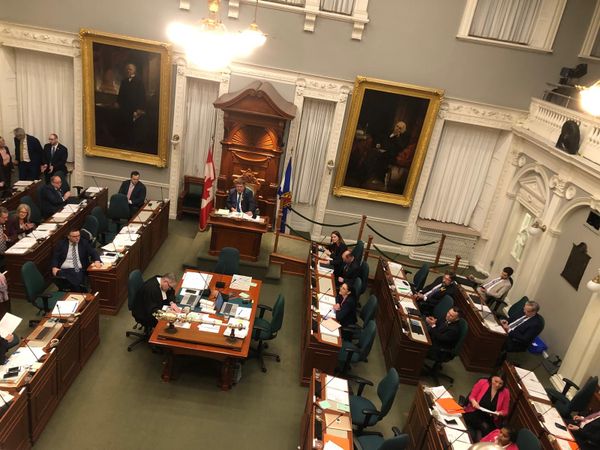
“Tap to pay… this is a mess. Unbelievable. It’s embarrassing,” said the exasperated councillor Tony Mancini, as he shook his head.

During the past budget season, council ran into the uncomfortable reality that the HRM has been built out in a most expensive sprawl. And on top of being expensive, there aren’t enough taxpayers to sustainably, affordably, and reliably fund basic municipal services and maintain critical infrastructure, like public transit and well maintained roads.

To add insult to injury these expensive unsustainable communities we’ve built also suck as places to live. What is a new subdivision of fiscally unsustainable, monochrome grey and beige, cookie cutter houses if not content slop mills made real? Don’t forget to add on the premium subscriptions of gasoline, car payments, and insurance with added risk of dying in a wildfire.

All this means transit is getting worse because it can’t be properly funded because people don’t want to pay premium taxes for their slop subdivisions. (Which, yes, suburbs do actually require a premium subscription in property taxes to be properly funded. Even though no one wants to pay it.)

This has been going on for long enough that there is a word for people in Halifax who have to rely on Halifax Transit: Unemployable.

Most employers are loathe to hire people who can’t reliably get to work on time.

Council doesn’t want to make Halifax Transit better or cost effective; they’d be reallocating road space if they did. But council does want to make it easier to pay to ride the bus for an hour and a half for what would be a 15 minute drive. Council wants to make it easier for transit riders to pay for the bus because council doesn’t want to raise taxes and make drivers pay for services, like transit, that drivers also benefit from.

Mancini, dressed in a crisp white vest which highlights the fluorescent lighting of the room, continued, “I don’t know how many months or years we are overdue on this project.”

Tap pay is approximately 13 years, 7 months, 1 week, 3 days, 20 hours and 6 minutes overdue when this paper publishes digitally at 6:06 a.m.

December 2012 is when Halifax Transit first realized that being a cash only service in a digital age was probably not good, and in response council passed the Halifax Transit Technology Plan. In 2018 when the plan was audited by then auditor general, Evangeline Colman-Sadd, she found the five year plan had no end in sight.

Getting tap pay on busses has always been the goal, during last Tuesday’s debate councillor Sam Austin reminded everyone that “at one point we were going to have tickets that were going to be this big,” he said while holding his index fingers and thumbs in a square approximately 2.75 inches by 6 inches, the planned size of what Austin called the “Willy Wonka tickets.”

These large tickets would have gone into large fare boxes that could eventually accept tap pay. This was back in 2018 when council was debating the fare modernization audit. And there was a bit of progress on the 2012 plan, it all just kind of fell apart.

In 2012 the city was already behind the eightball, after first being introduced in Hong Kong in 1997, ‘open loop’ transit payment systems were taking over. Open loop is like tap pay, but instead of using your bank or credit card, you use a transit card. And this transit card can be loaded with money in many ways including via app on a phone. But a full open loop system involves hardware, and hardware is more expensive. And even as the first open loops launched, it became pretty obvious that if you could tap a transit card, you should also be able to tap a credit or bank card.

To its credit, Halifax realized that a full open loop system would be needlessly expensive and already obsolete in 2012, so the plan was to start with an app, which was supposed to be cheaper and faster than a full tap pay hardware rollout. Then, once the app was up and running, start doing the hardware changes required for full tap pay.

As a bonus some hardware changes, like vehicle location upgrades, were needed for both app and tap and were relatively cheap. The city finished those upgrades in February 2014 when busses all got new modems.

The city then awarded the software tender to Trapeze Software ULC on August 1, 2017. Council paid $16,551,578 for the app, which was originally estimated to cost $11,863,799.

At some point between August 1, 2017 and the July 21, 2020 presentation of the Halifax Transit Fare Management Strategy Phase 2 the contract between Trapeze and the city was “mutually terminated by both parties.”

Due to wildfires, city staff were unable to answer how much of the $16 million was spent or reimbursed.

Only July 12, 2022 council decided to award a tender to Masabi Ltd. for $1,304,106 to provide a transit app and, eventually, tap pay. Masabi gets a cut of each fare as a commission (2%) and to cover operational costs (2.25%).

Even though the tender wouldn’t be awarded for two more years, in July 2020 technical services manager Marc Santilli promised the app would come quickly. On October 3, 2022 Santilli said “we hope to have everything signed in the next few weeks. And then after that, it’s a matter of four to six weeks in terms of rollout.”

The app was then pushed back and promised by staff summer of 2023, but in August 2023 then director of Halifax Transit (current executive director for Halifax’s office of strategic infrastructure and transportation planning) Dave Reage told then councillor Waye Mason that “we’re going to get into the fall before we have this roll out, unfortunately.” In an email in 2023 city staff clarified that “there is currently no hold up, everyone involved on the project continues to work through the process of delivering the project as quickly as possible.”

The bureaucracy of Halifax Transit is as reliably slow as their busses.

November 2, 2023, almost exactly 11 years after Halifax Transit staff were first instructed to do so, they finally delivered an app.

Finally, the city could now turn its attention to installing tap pay. And, although it was hard to remember 11 years on, one of the benefits of the app is that tap pay could be quickly implemented once the hardware upgrades (from 2014) and the app (from 2023) were both online.

Almost immediately, staff ran into two hard physical limitations to implementing tap pay.

The first was a bottleneck in installing the new tap-pay-enabled fareboxes. Halifax Transit can only install four fare boxes at a time.

And the second was that the busses needed new modems in order to accommodate tap pay. Although kind of a drag, these modems needed to be replaced anyway due to their age. These were the modems bought way back in February 2014 as part of the first step in this fare modernization update, so buying new modems was something Halifax Transit needed to do anyway because tap pay was taking so long to implement. Unfortunately, when placing the first order for the modems, staff only looked at user manuals to determine what modems were required. When it came time to install the modems they realized the ones they bought didn’t fit. On Jan 16, 2025 council approved spending $769,000 to fix this mistake.

Halifax Transit is famous for this type of inventory mismanagement. Back in 2014, they had a fuel spill so bad that it flooded onto a neighbouring property. Halifax Transit’s distinctively coloured gas was traced up a ditch to the Burnside bus depot and it still took six weeks for them to even acknowledge there was a spill. All in all Halifax Transit lost 200,000 liters of fuel without noticing. With today’s fuel prices, that is about $35 million in lost fuel. Luckily, back in 2014, 200,000 liters of gas only cost about $2.7 million.

Halifax Transit’s current director, Robin Gerus, was hired in January 2025 and nobly fell on his sword for his unit’s most recent blunder at last Tuesday’s meeting.

Earlier this year, during budget debates, council was debating whether or not to raise fares on transit riders. Council was hesitant to raise fares again so soon because they had just raised fares in 2024, and transit service only got worse after the hike.

Unlike driving (which gets government subsidies even though it kills people and the planet and causes congestion and hikes healthcare and insurance costs), public transit relies on user fees despite being an essential service for poor and disabled people. If poor people just worked three to five more jobs, whatever it takes, maybe they could afford a car and earn those government subsidies.

As such council felt it was okay to raise fares on the lazy poors as long as the increase came with better service. And since reliable, frequent bus service wasn’t an option, the fare increase was going to coincide with tap pay’s long overdue implementation.

Last Tuesday, Santilli (still manager of technical services) explained that Masabi, as a British company, couldn’t process transactions in Canada. They had to go through the payment processor Moneris, and it was taking longer than staff expected for Moneris and Masabi to integrate. Masabi expects this work to be done in early 2027.

Santilli told council that, like the modem mistake from early 2025, it was “only after we got started” that staff learned “the true timeline.”

Most councillors blasted Halifax Transit for being a colossal embarrassment to the city with some councillors, like Billy Gillis, clumsily pointing out that poorer, smaller, lower-density places have tap pay already. “I mean, I’ve been in rural villages in Mexico in the jungle, and they had tap and pay,” said Gillis. “Their little village busses.”

Closer to home, rural backwaters like Fredericton and Cape Breton Regional Municipality also have tap pay.

Halifax is expected to have tap pay on Dec 21, 2026, almost 14 years to the day since staff were first instructed to implement it.

The Other stuff

Book club has a new book! Dark PR by Grand Ennis. The exact time of the meeting is still TBD, but you can expect to be heading to the 5k Cafe sometime in late August or early September.

Did you know there is a podcast? This week there isn't really. But normally there is. We'll be back for real next week with either a scouting report on Halifax's new CAO or a bit of a deep dive into how sovereign and independent Halifax really is.

Here is the paper for your printer at home

How did you do on last week's puzzle? Here's the answer!